Showing posts with label Spare Thoughts. Show all posts

Tuesday, September 22, 2026

University towns

I recently visited Bologna, which lays claim to being one of the oldest universities in the world, and, by extension, one of the oldest university towns.

For me as an academic, such towns have an immediate appeal: their tone and bearing feels familiar and filled with calm, purposeful energy. Universities face many challenges at the moment, and the Humanities are frequently said to be under attack. At the same time, visiting university towns helps to remind me of longer timeframes and an enduring presence.


Tübingen, Germany

Heidelberg, Germany

Oxford, England

Halifax, Canada

Basel, Switzerland

Centre for Arts & Creativity, Banff, Canada

Bologna, Italy
Durham, England


Bangor, Wales

(All pics by Kári Gíslason)

Monday, August 31, 2026

Iceland and the wider world

Next week on our Viking Lives podcast, Richard and I will be telling the story of Iceland's conversion to Christianity in the year 1000 AD. This moment in the country's history is described in a number of medieval works, including several of the sagas and Íslendingabók (The Book of Icelanders) by Ari the Wise, an historical account that dates from 1130. As scholar Siân Grønlie has observed in her introduction to Ari's book, the conversion as we find it in Íslendingabók seems to witness a "resilient secularism" in how the change was approached and understood. 

In the 990s, King Ólafur Tryggvason of Norway had been pressuring Iceland to convert. The king sent missionaries to Iceland and took Icelanders living in Norway into hostage and threatened to kill them if the country didn't adopt the new faith.

The question of whether to do so was taken up at the national parliament at Þingvellir. As the debate proceeded, and it began to look like there would be a battle on the assembly grounds, the news arrived that a volcanic eruption has started. The heathens proclaimed that the gods were showing their anger. Snorri goði, a chieftain from Helgafell on the Snæfellsnes peninsula (where there is, indeed, quite a lot of lava), pointed at the older lava fields near the parliament and asked, 'Then, at what were the gods angry when they created this?' 

He asked the question as a way of supporting his case for Christianisation and neutralising the heathen's point, but it is one that also suggests a degree of scepticism about the role of divine figures in the lives of humans more generally. He seemed to have a level-headed view of change.

When the two sides of the debate couldn't agree on whether Iceland would become Christian or remain true to the old gods, the assembly asked the Law Speaker, Þorgeirr Ljósvetningagoði Þorkelsson, to make the decision on the country's behalf. Þorgeirr was himself a heathen, but after deliberating underneath his cloak for a day and a night, he announced that Iceland would, from then on, be a Christian country. The parliament accepted his decision, one that was about religion and at the same time about how Iceland responded to the changes in the wider world. It might join in the changes occurring elsewhere, it might not, but it would make decisions that expressed faith in its own systems and institutions: the parliament, a single unified legal code, and the office of the Law Speaker.

And also, perhaps sensibly, noting what the king of a more powerful neighbour though they should do.

A thousand years have passed since Iceland adopted Christianity, and as in other countries the role of the church has changed. Iceland was of course initially a Catholic country, but with the Reformation a Lutheran one, and it has a Constitution that guarantees religious freedom for all. Two hundred and sixty-odd years after King Óláfur got his way, Iceland became a Norwegian colony, later a Danish one, and in the twentieth century was able to reclaim full independence. The country sits rather apart and also over the North Atlantic ridge, and will always be pushed this way and that.

Over the past few weeks, I haven't heard much mention of the sagas or of Ari the Wise during the country's debate over whether to initiate talks with the European Union about future membership. Tying EU membership to the stories we find in medieval sagas would be a stretch, I know, even for a saga scholar. But from where I followed the debate as the No vote took the day, from far-away Australia, I noted some familiar-sounding predictions of social eruptions, fissures, and ruptures. I wondered if perhaps a little bit of Snorri goði was in order, his wry scepticism that has always struck me as being very Icelandic in its way. 


Þingvellir National Park, Iceland (pic: Kári Gíslason)


Monday, April 29, 2024

'Just Enough'

Yesterday, Irish writer Claire Keegan was interviewed by ABC Radio's Sarah Kanowski at the Brisbane Powerhouse. 

The conversation began with a discussion of Keegan's rural childhood, including that she had little access to books while she was growing up. Keegan said she felt that their absence wasn't a hindrance to becoming a writer. Rather, it created a 'longing' that helped to shape her own storytelling.

When the conversation turned to the writing process itself, Keegan seemed to resist reflecting too much on how she finds and develops her stories, or their themes, echoing comments she made in a Guardian interview last year. Her emphasis, rather, is at the sentence level: creating good prose, and selecting events with great care. 

Her commets reminded me of something Annie Proulx said in an interview with me some years ago: good writing is about good sentences. Themes, it seems, will take care of themselves, and for the most part meaning can be left to the reader. As in the Guardian interview, Keegan also talked about wanting to give the reader 'just enough', comparing this approach to writing to a good meal or a good conversation, when just enough is served or spoken about.

In the case of Small Things Like These, the result, I think, is a work that has fable-like, even saga-like qualities, revealing its meaning and political imperative in a structure that becomes more visible through selection: leaving things out, so that there isn't too much; creating a certain longing within the omissions.


Sarah Kanowski and Claire Keegan at the Brisbane Powerhouse

Saturday, March 12, 2022

Week 13: Riverbend

Good bookshops care about both writers and readers, and are often sources of employment for young writers and critics, editors and publishers. Many of my own students have worked at bookshops during and after their degrees.

Yesterday, I drove across town to visit one such place, Riverbend Books in the riverside suburb of Bulimba. To me, this part of Brisbane feels a little separate from the rest of the city, I expect because of the way the river guides such suburbs along its bends and peninsulas and through to its further reaches. But Riverbend Books is itself wonderfully connected, and has long been a hub of literary life in the city. It hosts many talks and events, plays a key role in the Indigenous Literacy Foundation, and is a strong supporter of local writers and publishers.

I first met its owner Suzy Wilson in 2011 when I published The Promise of Iceland. Since then, I've been a regular visitor and have spoken at a number of the bookshop's events. Suzy reminded me that last time I was there, for a talk on Saga Land, I mentioned the so-called jólabókaflóð ('Christmas book flood'), which is the Icelandic name for the publishing of lots of books around Christmas, and also the practice of always giving books as Christmas presents. It seems the term resonated, for soon after I gave the talk a Jólabókaflóð Bookclub was formed at Riverbend and has been going since.

Such connections and responses are engagingly unpredictable, and they're also a reminder of how a bookshop hosts exchanges which create new currents and ideas that can then take on their own life. It's about four years, I think, since I mentioned jólabókaflóð at Riverbend, but really that's not so very long to hear back about the impact of a word, and what emerged as a result.


With Suzy Wilson, owner of Riverbend Books

The Sorrow Stone is currently Riverbend's 'book of the week'


Friday, February 4, 2022

Week 8: Positive

Along with some 265,000 other people in Australia, this week I tested positive for Covid-19, I suppose an inevitable thing given that I have school-aged children who do a lot of team sports and given, too, that I haven't confined my activities beyond the usual confinements that come with my life in writing and research. My daily patterns are so regular at the moment that I should be able to identify when I caught the virus, but I haven't got a clue. It's everywhere, after all. 

I have only mild symptoms. Being positive is an odd feeling, nonetheless, I think because for two years I've been observing the spread of the virus in that procession of graphs, models, figures, statistics and maps that have dominated the reporting of Covid, but that don't really tell us much about the humanity inside or behind the numbers. When the virus first emerged in early 2020, I followed these numbers almost obsessively, and it was difficult to concentrate on anything else. The world outside was falling quiet, lockdowns everywhere, but it was harder to locate an inner quiet that might be productive. Now that it's busy outside again, that inner point of reflection seems easier to find; I'll use the next week or so in quarantine to write, and to plan this year's teaching.

But, perhaps because the virus has caught up with me personally, my thoughts also keep returning to its beginnings. I recall my travels with my family in Christmas 2019. We visited my brother-in-law in Milan, and then took a friend's suggestion to spend a couple of nights in Bergamo, where a few months later the virus hit with such terrible force. When that happened, we were back in Australia. I couldn't quite believe the reports that were coming from the town, or that it could be the same place we'd seen, with its magnificent old streets on the hill and vibrant new town beneath. Its life and pace and glamour, old-stone beauty and narrow, crowded lanes of apartment buildings and shops. How could all that be quietened so quickly? How did the people in the town cope with the loss of so many? 

Two years later, the sense of unreality has largely been replaced with an acceptance of the virus's ever-presence. But that unreality is also still there, returning faintly, when I get the text message saying I have tested positive and must 'remain at your nominated place of isolation for seven days', mostly here at my desk.

*

Yesterday, I was interviewed (by phone) about The Sorrow Stone by Rebecca Levingston on ABC Brisbane. One of the nicest parts of our discussion was hearing Rebecca read a short passage from the book. After residing so long inside my own mind, it was wonderful to hear the words spoken by another person. It felt like a new introduction to Disa, someone I've 'known' for years. This is the passage she chose:

We rode Faxi out of the yard, down past our neighbours’ farms, along the river and past the woods until we reached the white pebbles at the beach. Everything was in a glaze under the sun. The water was so clear I could see my feet and the lines on my toes. The boys took off their shirts and ran ahead. I stepped in more carefully and lifted my dress. The water was a mirror around my waist. I saw my long hair and braids. My eyes that people said were too hard.

The full interview is available here, beginning at 2:13:00 in the online recording.


Bergamo, December 2019


Friday, January 14, 2022

Week 5: Borders

At 1am tonight, the Queensland border will fully re-open to the other states and territories of Australia. Strict border restrictions and controls were introduced in 2020 to limit the spread of Covid. At the same time, they have reminded us of the nature of the Australian federation: the states are largely responsible for health and can limit free movement to and within their jurisdictions. As a result, during the pandemic we've seen different parts of Australia adopt their own approaches to managing the crisis, and internal borders have become almost as powerful and defining as our international one.

The desire for boundaries is ever present; it's not just a Covid thing. We see it every day in the news, in political gestures such as Brexit and in anxious deliberations about what to do about a tennis player who arrives unvaccinating, but all around us, too, at least in my suburb, where each year more and more tall, block-out fences guarding property and privacy replace the see-through and lower fencing that used to dominate in Brisbane. Boundaries limit access, and assert ownership and responsibility, and in this way they are meant to keep us safe.

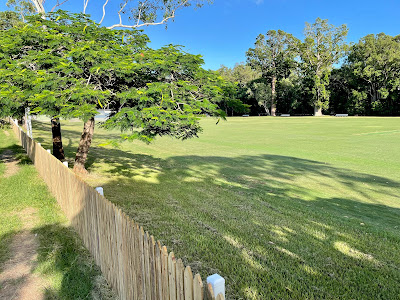
This week, one of the local schools in my area has replaced the fencing on a length of ovals that everyone calls 'the flats'. Even though they belong to the school, these ovals are always being used by others, I'm sure with the school's approval, for the old fencing was only ever some steel rails that seemed designed mainly to keep cars off the grass. In some places, it had even become embedded in tree trunks and encased by branches. The new fence is similarly porous. Though it's a wooden picket fence this time, there are plenty of gate-less openings and it is only waist high, that is, easy to jump or step over. The fence will do a job in keeping cars off the grass and cricket balls from running onto the adjoining road, but the ovals remain in full view. They are open, and different kinds of safety (that come with community health and enjoyment and sharing spaces) will no doubt result.

*

In arts and literature, boundaries are often questioned and tested and made fun of, but of course they're just as powerful as other kinds of social and cultural borders, for they're used to define credibility and expertise and to gauge and even predict the value and quality of a work. The divides between so-called capital "L" literature and others kinds of writing, between forms, and between art and entertainment are seen as old-fashioned and unnecessarily value-laden, but they're regularly asserted nonetheless - in prize culture and 'best-of' lists and grants and the shelving and labelling at bookshops - and writers and artists who work across forms are sometimes viewed as diluting the impact of their best work. I suspect a belief in borders is behind this kind of approach, and that its valorising of singularity and isolation, and purity of form, is something that most artists and critics would find disturbing in other contexts.

This morning, in a moment of idle thought as I drove past the ovals, I wondered what would happen if the government declared that from 1am tonight there would be no more borders between art forms - film, literature, visual arts, dance, music and all the others. From 1am precisely, they would be as welcome in each other's territories as the people of Australia are now welcome to come to Queensland. If there is to be a fence between literary fiction and genre novels, henceforth it will only ever be waist high and easy to jump over, just like at the flats.


Thursday, June 10, 2021

Clive James and the tensions of multimodal authorship

I recently published a scholarly article about Clive James that explores some of the tensions of multimodal authorship, and in particular the critical reception of a writer whose practice crossed many forms and genres.

I've long loved Clive James's essays and travel writing, and have analysed some of these in this blog; but he also wrote poetry, fiction, song lyrics and, towards the end of his life, translated Dante's Inferno. In my article, I wanted to show how a sympathetic critical response to this writer can celebrate his multimodality rather than, as has sometimes been the case, seek to identify his main strength and wish that he focus on that alone.

Many writers are experimenting across forms and genres, and so sometimes it's better to evaluate a writer's output by looking at the whole picture, and how individual pieces relate.

The article is available for free here.


Sunday, July 15, 2018

Swimming Lessons

I recently published an essay about the relationship between swimming, writing and migration. Although I'm always writing about Iceland from here in Australia, and writing about my birthplace as a presence in my life, I sometimes manage to forget that I'm a migrant.

The essay, written for an anthology celebrating the 70th anniversary of the University of Queensland Press, is an attempt to remind myself of that - how I moved here as a teenager, and what it meant to live in a very different place.

And of an odd but, for me, very real connection between the countries that exists in the water. Shared rhythms of swimming and writing.

The anthology is available here and from other bookshops. A full list of my publications here.


Friday, July 6, 2018

In-between


The months since the publication of Saga Land last October have been intensely busy. My co-author Richard and I travelled widely in Australia to talk about the book - at festivals, industry nights, on TV and radio, and at local workshop and bookshop events.


At the same time, I've taught three subjects at my university, and, with a colleague, started a new seminar series called On the Terrace. It's about contemporary issues in creative writing. For the first seminars, our guest speakers have been authors Anita Heiss, Nick Earls, and Rohan Wilson; poet Sarah Holland-Batt, arts producer Jane O'Hara; and broadcaster Sarah Kanowski.


But despite all this busyness, the past months have also felt like months in-between; that is, between finishing one big thing and properly starting another. This is when writing, to me, feels like sketching, and almost like watching one's thoughts rather than following them.


And then, quite suddenly, it changes. The writing is real and takes you with it. To Iceland, in fact. In September, I travel back to the mid- and north-west of the country, as in Saga Land in pursuit of people who lived there a thousand years ago, but now with rather different writing goals: to produce a novel.

The book takes place at two farms. I hope to spend most of my time walking around them, and the countryside nearby. Following this book begins by following in the footsteps of those who lived here a long time ago, and getting around as they might have.


Monday, July 17, 2017

Hinterlands and Understories


I've recently had the pleasure of launching two books, Hinterland by Steven Lang (UQP, 2017) and Understory by Inga Simpson (Hachette, 2017). They are rather different works, the first a novel of manners, the other a nonfiction work of nature writing. But they're connected by their setting in the hills and valleys inland of Queensland's Sunshine Coast, and a desire to figure place as a key element in storytelling.

I gave speeches at both of these launches, edited versions of which are given below.

*

Hinterland

This book is, in many respects, one about place – or, places, and the way in which different places can influence one another; how they come to develop a kind of conversation about influence and exchange: about whether to accept changes that come from outside our immediate surroundings, changes that are sometimes forced onto us; and about how we communicate our own, local points of view, character, desires to the wider world. How we might come to influence them with our stories and points of view.


I’d to talk a bit more about place now. It’s a touching point between my own work and this book, and certainly it’s one way of reading Hinterland.

I arrived in Australia as a teenager, and I’ve been driving up the scenic hill road to Maleny pretty regularly ever since. It was one of the first places that I was taken to visit when my mother and I migrated from Europe in the 1980s. I recall that we climbed up the road quite slowly in a long, white Ford Falcon 500 with its windows down. I sat in the back seat; the engine noise got louder as the car strained a little, but the air outside cooled as well, freshened, and then at last we reached the crest of the wave, and a winding road that we followed until we arrived at a damp, wooded car park which was at the entrance to a rain forest walk. We were going to do the track, and in a moment I’d have my first ever encounter with leaches.

It looked like the entrance to another world, one hidden by a high canopy and revealed only in the shots of light that made it through. But there was also something quite familiar to me here. I’d spent my early childhood in Iceland and England. To me, the Glasshouse Mountains seemed connected by their shape to the volcanic island of my birth. And, nearer to us on the other side of the road, I saw pastures where dairy cows were grazing, very much as in the rolling farmlands of Cheshire, from where I’d just arrived.

And yet no doubt the reason I’d been brought to Maleny, was actually so that I might experience the distinctiveness of this place: how this hinterland environment was different from the landscapes that I’d come from, different from those of the coast, too –that is, the Australia I’d been expecting.

But through it all I recognised something deeply familiar, more so than the surface terrain. I saw that this was a kind of island. Before we walked into the forest, I sensed that I’d arrived at a place apart, away from the greater wonder of Australia: rather like Iceland and Britain are islands apart from the Continent.

I’ve been talking about Maleny. That’s because I think that’s very probably the place we’re reading about in this book, a small town in the Sunshine Coast hinterland; although, Steven has given it the name Winderran.

But as crucially we’re reading about a town that has this powerful sense of its apartness about it. The hinterland is home to a community that either all know each other, or grew up together, or are at least spatially aware of each other – and perhaps more acutely aware of change as a result being such a constant in each other’s lives. There are well-established families with long reputations to protect. And new arrivals, who are needed, but who may disrupt the patterns of life, customs. However well-meaning these new people are, they sometimes seem more like pirates, for they take away the certainties of the old ties and family connections.

Ideas can be pirates, too. Or, more to the point, government proposals can be. Much of the tension in this book comes because of a proposed damn that threatens to engulf farms and forests, and at the same to time sweep away much of the community’s sense of self-determination. The town doesn’t need the damn; the demand comes from the outside, and really the need of the coast. Suddenly, the village of Winderran is being told to change in order to meet the demands of the world beyond it. It’s being made to look different.

The literary result of this threat, of course a real one, is here a rich type of work that’s called a novel of manners, or novel of manners and morality – some way into the book, Steven does hint to us that this is the kind of story he’s telling, with a reference to the genre. This, then, is in a way a nineteenth century novel – not old-fashioned, but very definitely a study of how a particular community deals with key ethical issues of its age, here water, and how that community reveals itself through its reactions to that issue.

The hinterland is separate, but if it does form a micro-climate, it’s also one where the elements are familiar to us all: entrepreneurs running a little wild without much clear sense of purpose; muscular Christianity with perhaps too much sense of purpose; counter-culture and protest; illness – time and again, characters are understood by the way they cope with physical decline. There’s even a writer in this book, although it has to be said he’s not the most likable of the cast: he’s more or less thrown in his writing in order to pursue a career in politics. How could he?

And the cast is large one. It’s there to give us a full portrait of the town, and the range of manners to which it bears witnesses. But ultimately it is two people, a nurse called Eugenie and a newcomer, Nick, who form the most important setting of the book, its ultimate island, if you like – the one that two people manage to make when they look for each other, and look out for each other, and find a space together, even among a crowd or in a busy village life. This is a book filled with many places in that village: the hall, meetings, creeks, dinner parties, empty roads at night, a surgery, and then also the private world where people at least try to keep the rest of the village out.

In this, I was reminded of a poem by John Donne. In his work, ‘The Sun Rising’, the poet makes fun of the sun for thinking that it illuminates the world. Doesn’t it realise that the world has been contracted to a single room, the one he shares with his life, a location of its own, governing all. This is a kind of fantasy, of course: there is no perfect isolation, no one place where the sun has done its work if it but rests there. I learnt this from going back to my birthplace of Iceland, a country that stood apart from the rest of the world for a long time, and more or less fell in love with its separateness. Being separate can create a feeling specialness, and over the years Icelanders have learnt to make fun of their exceptionalism, even if they still believe that the sun need only shine there in order for it to shine everywhere.

But these days, when I visit Maleny, it’s with the warm memory of the first time I went up, and recognised and really enjoyed the separateness of the town and its environment. As in Reykjavik and I’m sure in many other places like it, the slight air of isolation has created intensity and energy, and Steven’s book responds to that energy, and very faithfully I think, reproduces it as a portrait, an island study revealing many colours, weathers, and tracks.

The last couple of times I’ve visited I’ve also had the pleasure of meeting with Steven at literary events. He’s an important part of the cultural life of the town. Sometimes, as I read the book, I found myself looking for him in the characters, and wondering which aspects of his life have found their way into their depiction. When we write about other people, especially fictional people, we have to give a lot of ourselves.

What’s most important now, of course, is that this book is now leaving its inland island home and voyaging outwards, towards readers curious about how this remarkable region thrives, and fights, and loves. In this book we are very much invited into the town of Winderran, and we’re asked to meet the people there as we would, I think, meet them in life: each made up of good and bad qualities, complex people, neighbours who are sometimes good to have around, but not always good to have around.

*

Understory

This is a captivating work, and also a book about quiet moments, about place, about stillness: we’re in a cottage, we’re hearing about years spent living among trees that surround it, and Inga’s desire to understand and protect these trees, the habitat they form, and to honour the country that she lives in, including the many stories that the country holds: Indigenous stories, stories of European colonization, the stories the plant life, and of course her own.


The chapters of Understory form a kind of woodland – a very varied one. Each chapter is named after a variety of tree found on her property. These chapter titles turn out to be thematic as well as botanical: we learn about each particular species, but alongside that we also learn about how trees can, in a sense, speak or help us to speak – and so how in this way join the story of those who live with them. Inga’s curious about the natural world that surrounds her, and observant, too: she reads voraciously, but she also watches life as it develops its own patterns around her, its own chronology and tempo. She is drawn to that, and wants to include something of this new chronology in how she lives.

As Inga writes about her experiences, she becomes a more astute observer, too. In this way, the book celebrates a symbiosis between reading, writing, and living: breathing it in so that we can express ourselves. We get to walk through the forest with Inga, with her as a kind of fellow student, but we also learn about the difficulties of the choice the she and her partner make when they leave the city. This book doesn't complain, but nor does it shy away from the realities of building a kind of retreat.

I expect we all have our own ways of retreating from… what, the world, the routines we’ve gradually accepted as normal and sane, enough. Or, we all have our own ways of finding retreat. Maybe that’s better than the verb. Retreating sounds a little too much like leaving, or running away in the middle of a battle. This is book isn’t about that kind of retreating, it’s not escapist; it's about moving towards the world, not away.

As a beginning, this means moving to the ten-acre property that Inga and her partner buy. It’s their family’s own retreat. She and N, the name that Inga gives to her partner and the other major person in this book, are looking for change: from jobs that don’t quite fit them, from crowded city housing, traffic noise, concrete. But more so than leaving these things, they’re on the move towards a fuller writing life.

To start with, Inga seems a little concerned about what she’s leaving behind. The cottage has some problems, and she’s going to be a long way from her gym. But she soon realises that the work of maintaining a property of this size will make up for missed workouts. Setting up in a new place is demanding in many ways: it puts a strain on those jobs in the city now a long commute away; living in the country makes it hard to even keep a job. It creates a new family dynamic. But, still: who wouldn’t swap crowded urban living for trees, wonderful bird and animal life, and a little bit of distance from all this rushing we do?

Well, to be honest, probably I wouldn’t. Or, better said: I wouldn’t manage it very well.

I love cities and all the noise. I’m not very handy, and, I have to admit, a bit afraid of chainsaws and power tools. But of course I get it, and in this case I get it because Inga allows us into her life, her desires and hopes, her story. This is a generous book, because it’s looking at the world generously. Her cottage is just a cottage in the forest, but, as Inga puts it, “it isn’t what is there, but what we see. It’s what we bring to a place, and what it gives us.”

Clearly, for Inga this is where she should be living. As much as escaping the city, she’s moving towards a world that is right for her. She begins to read nature writers, and realizes that in her writing she is joining a community of writers who have sought out something similar. Other forms of retreat develop. Some of these are less than straightforward. When the property next door comes up for sale, Inga and N are desperate to buy it. They’ll have to borrow a lot more money, but doing so will allow them to begin a writer’s retreat, where they might create a place for people, like them, who wants to write more.

At this point, the year is 2008, the banks are enormously confident and very willing to lend money – what could possibly go wrong?

I think this must be around the time I first met Inga. I’d just come back from a few years living in Iceland, and I’d begun a lecturing job at QUT. Inga was finishing her PhD in creative writing, and I was part of a final panel that read her thesis just before it was submitted. What came through then, as now, was Inga’s ability to pair creative writing techniques with different, searching kinds of inquiry.
Inga manages this movement between styles and modes of address very fluently. The book is an interplay of past and present, intimate perspectives and expansive ones. But the techniques she uses are not there for their own sake; the writing is never showy: they serve the work, one that subtly combines reflection about the writing life with botanical observation, family, philosophy, and a story of the ten years that follow the purchase of the cottage, and the writer’s retreat next door.

Across the years, it becomes apparent that what we’re really reading about is the strange and often strained, but magical, task of trying to create what you want, what you protect and nurture: literature, the natural environment, relationships – and memory, too.

Tuesday, July 23, 2013

Riverbend Party

On Thursday 25 July I was MC at Riverbend's 15th birthday party, which featured special guest David Malouf.

Here is an extract from the introductory speech I gave:

They say you shouldn’t meet your heroes.

I’ve never been entirely sure who ‘they’ are, but I think they probably have a point. There’s a lot to lose, not least an aspect of your own inner voice – that voice that you give to books and their authors, and that has come to be part of you; in a way someone you’ve invented, but most certainly someone you think you know. We know our authors, and we know our heroes, because they articulate and enrich a particular kind of dreaming – the one that you get to part author yourself. Who wants to lose that? And yet if I had my chance, I think I would always choose to meet my heroes.

A colleague tells me on Twitter that he made Riverbend’s first book sale. When I asked him which book it was, he replied, ‘Well, it was the 90s, probably something about Provence.’ I pressed him to remember more. Yes, he remembers selling a lot of the Peter Mayel, many copies of Captain Corelli’s Mandolin and then also The Liver Cleansing Diet which, I quote, presents an “eight-week plan for promoting good health and longevity by effectively cleansing the liver” and “comes complete with groundbreaking recipes for healing soup and raw juice concoctions”.

Some of you may have bought all three. If so, I should ask you how your livers are, and whether you ended up getting to Provence. But if, like me, you find liver cleansing a slightly terrifying thought, then I suppose there’s some solace in the fact that diets do tend to come and go, and it seems can always be left off until after the weekend. I hope no one is thinking too much about their liver tonight. We are here for a birthday party, and to celebrate being 15, when presumably all livers are yet to need cleansing.

Diets are meant to be forgotten, but good books stay on, and like people they sometimes gain weight as the years go by. We return to them, read them in different ways, and experience our heroes afresh. Each time, we listen to them differently, and this allows them to develop with us. When I first arrived in Brisbane, I had some trouble understanding how I’d come from Iceland to England to here. I was coming up to my own fifteenth birthday, but didn’t quite know where to put the changes that had occurred in my life.

But the first book by a Brisbane author that I read gave me an introduction to the city, or perhaps to a new way of thinking about the question of how I belonged here. It was a book that revealed something that, perhaps strangely, I hadn’t yet associated with Brisbane – writing and language – and helped me to realise that my imagination had not yet caught up with the fact of my migration. If I wanted, it could. For in this book Brisbane was not only a place of beauty, but, as importantly to me, a place of beautiful language. It was Antipodes by David Malouf.

David Malouf cuts the cake

So, I am meeting one of my heroes tonight, after all, as I’m sure others are, too.

They don’t always need to be here in person. We meet them, most profoundly, in their writing. And bookshops are the places where those first meetings so often occur – the pleasure of chance encounters, of browsing, walking in without a book and walking out with one. As with libraries, friends’ studies, guest house collections, bookshops give us more than a set of choices; they give us a shared bookshelf – just as books give us shared voices.


Pics: Riverbend Books


Wednesday, July 3, 2013

Brisbane accents

On Tuesday 2 July, I spoke at the launch of the 2013 Books From Our Backyard, a Queensland Writers Centre publication that catalogues works by Queensland writers.

*

The first words I remember hearing when I moved to Brisbane in my teens were, ‘Good, thanks’. We’d landed. Asked our hosts, Laurie and Margaret, how they were going, and that was their reply. But I’d never heard anyone say they were good before – to foreign ears, and in my case Icelandic-English ears, this sounded more like a moral disposition than a description of how you were feeling.

But when, on the way out of the airport, our hosts paid for parking at the security gates, I discovered that the words were even more flexible than that. Margaret put her hand out for the change and, when she got it, said again, ‘Good, thanks’. It was a gesture of appreciation.

Perhaps I was unusually aware of such matters. In the English boarding school I’d attended in the years before our move, it was whispered that Australians didn’t take kindly to proper-sounding English migrants, and I knew my accent was particularly proper. So when we got to Laurie and Margaret’s house, I asked how long they thought it would take to acquire an Australian accent. I had two weeks before school started. Would this be enough time?

A side note: two weeks later, my mother asked the school principal whether it was normal for children to bring leather briefcases. In reply, he asked whether I would also be wearing a bowler hat.

But that first night in Brisbane I was content to practice that first phrase: ‘Good, thanks,’ I repeated it as I fell asleep. And in the weeks and years that followed, I worked hard at the edges of an accent that I thought might one day get me into trouble. It never did. And much later I discovered that the girls at my school, which sat a couple of streets back from the dark beach of the north Brisbane waterfront, rather liked an English accent. Apparently, it had been one of my better qualities. Before it was gone.

Over the years I also learnt that accents are complicated. You don’t defeat them in a two week crash course. Like language itself, accents tends to ebb and flow, often closer to the past than the present, sometimes returning when you don’t expect them to. You sat and looked at the pale blue water, while language swept across the beach and out to sea, returning you to distant shores even before you were familiar with new one ones. That was the story of my migration, after all. Like other changes, it occurred gradually – in pulses. There are parts of me that are still coming in to land, or are only just off the runway, or waiting for change at the boom gates, so that I can say, ‘Good, thanks’.

Shorncliffe Pier, Brisbane

Yet I’ve always felt that, in Queensland, there’s room for a degree of tension around personal change. It might be because, at least in the years I’ve lived here, change has been such a noticeable part of Brisbane life and indeed Brisbane writing. In retrospect, I don’t think I needed to have rushed my accent away, and I should have learnt this sooner than I did. For the first Queensland book I recall reading was a collection of short stories by David Malouf, called Antipodes. It was a very Brisbane book about the push and pull of the new. But I hadn’t yet properly realized that that was part of Brisbane’s character, and so didn’t necessarily need resolving in my own.

A better understanding, though, has evolved alongside writing, and alongside my joining a very strong and warm writing culture that thrives here. I have written about my birthplace, but in so many respects, I have actually written a Brisbane book. It was composed here, picked up by Madonna Duffy and published by our immensely important UQP; and subsequently it was supported by our literary festival, the Courier Mail and the Literary Awards, QWC, and other members of our cultural community. I’ve wondered whether it wasn’t a book that I had to be here to write: in a way, it was written with an Australian accent, or my version of it. And it was written for people who understand that accents are often complicated things.

Pic: QWC

By nature, every writer must have their own sense of what Brisbane writing is. In my case, it began with an arrival, a collection by Malouf, and eventually came to be embodied not only in my wider reading of his and others' books, but more immediately in the creative and critical work of my friends and colleagues. And for me, it also resides in that feeling that, while language and stories sometimes take you out to sea, they also often bring you home, and if necessary to your various homes all at once.

This is a busy and exciting time to be writing in Brisbane. As elsewhere, creative writing courses are very popular in universities and other institutions, and this is already having an impact the depth and variety of writing in our state. The same pulse exists outside formal programs in what is a strong and open literary community, one that’s defined as much by what’s to come as it is by literary precedents: we have new journals appearing (such as Stilts and Bumf), new literary events (such as Yarn and Whispers and Avid Reader’s Salons), while our established authors are producing some of their best work.

This is certainly a moment to celebrate the accents of Brisbane’s literary life, and equally an exciting moment in which to support and document these accents with publications such as this one.

With SLQ representative Jane Cowell, Minister for Science, Information Technology, Innovation and the Arts Ian Walker, QWC's CEO Meg Vann, and Chairman of QWC Kevin Gillespie (Pic: QWC)


Monday, May 20, 2013

Read What You Want?

On Saturday 18 May I took part in a (tongue-in-cheek) debate that examined the proposition it doesn't matter what you read, only that you read. My team mates (authors John Hughes and Michael Jacobson) and I were given the task of supporting the proposition. John emphasised the importance of a varied reading life, Michael a free reading life, while I broached the topic of reading pleasure.

*

Pleasure may not be the only principle of reading, but it’s probably the least fallible. That was W H Auden’s view, and it’s the point I’d like to reach for here.

When you’re told that reading is more important than what you read, I think what’s being said is that it’s okay to read whatever you want. We could express the proposition this way: reading what you want is the most important thing. Of course, we’re always being told what we should read. This can make the things we want to read a kind of guilty pleasure, which is not bad thing in itself. In fact, you could say that reading what you want is even more fun when you shouldn’t be reading it at all.

For me, as a student, the constraints were simply time and syllabus. We were meant to read about a book a week in each of the literature courses I took, but for me that made them a task. And once I have a task, I slow down and become resistant.

So I read other books instead, even books that had once been banned, supposedly left off all the reading lists because they were dangerous. I began an affair with them, and I even fell in love. Connie Chatterley had first been seen as a figure of moral decay, and then perhaps even an object of ridicule – when a rich woman’s romance with a gamekeeper was no longer taboo but simply the opening premise of a good romance. I loved her all the same, I wanted a share of the action, at the prose level of course.

And then I did what Julian Barnes thinks all writers should do, at least at some point in their lives: I fell in love with Emma Bovary. Even though she wasn’t on the reading list. Or maybe I was falling in love with Flaubert, her author; and the immediate, startling pleasures of his imagination. I wanted that imagination for myself, but perhaps most of all I wanted Emma. I knew, as others have said, that she would rob me, humiliate me, bore me, and eventually run off with one of my friends. She wasn’t in any sense good for me. But she was Emma Bovary.

And I also read books that were being forgotten, like the sagas of medieval Scandinavia, which had once been taught and valued, but whose reading time seemed to be up. In them I found other heroines, including Gudrún, who once said to her son that she was worst to the one she loved most, the words of the first page of Burial Rites, a book by an Australian writer who, it seems, read what she wanted and now writes what a great many others want to read. I don't know Hannah Kent, and the connections that books make are unpredictable. But I dare say that she fell in love with Gudrún, and through that reading, and others, Gudrún lives on. 


Where does reading for pleasure take you? When I read a draft of this speech to my four-year-old son Magnús, and asked him, he replied that it takes you to a pirate ship. Yes, why not a pirate ship. For he’s right: books are thieves and buccaneers. They kidnap you and hold you ransom to your pleasures. And so reading takes you in unexpected ways towards yourself and what you want in your life. That is why you should read what you want. It’s the least fallible method.

*

But do I really support the proposition? Well, I for one have been very grateful to have had well-read people tell me what to read, why I should read it, but as importantly how to read it. Ultimately that's what universities can give you: a reading list and the methods to embark on it. And of course the argument I make above is in many ways an argument against the proposition, for I am saying you should read for pleasure, but as long as it gets you somewhere interesting, or towards something actually worth reading.


Sunday, October 21, 2012

Tübingen Again


It's the last day of a short, second journey that I'm making to Tübingen, where I have been collaborating on an article with my friend and colleague Stefanie Gropper. We've met for two hours a day at a corner table of Schone Aussichten, a cafe on one of the town's two main roads, Wilhelmstrasse. The name of the cafe means something like 'beautiful view', with the double meaning of not only the view you see (here, a pavement busy with students and bicycles and then the park on the other side of the street) but also your prospects more generally: 'a good outlook', I suppose, in English.


Stefanie and I are writing about conceptions of authorship in medieval Iceland, a topic that has either explicitly or implicitly stood behind most debates about the Icelandic sagas, in some measure because the sagas themselves don't have much to say about it. Saga authors remain anonymous, and there's no medieval account of saga composition for us to consult; there's plenty of room for modern scholarly curiosity.

My days have been divided between these discussions, my own work on the article, and long walks around town. My thoughts have sometimes drifted to language and why we write, and what aspects of language and composition are common across the ages. In the evenings, I've attended some of the jazz concerts being held this week - my visit happens to coincide with Tübingen's Jazz und Klassik Tag, an annual festival that itself coincides with one of the most beautiful times of year, what the locals refer to as Golden October.

T. S. Eliot used the phrase once, as well:

Since golden October declined into sombre November
And the apples were gathered and stored, and the land became brown sharp points of death in a waste of water and mud. 

     - Murder in the Cathedral


But Tübingen's not there yet. In fact, the decline into November has seemed but a distant threat during day after day of glorious sunshine. The temperature has been in the low- to mid-twenties, and if it weren't for the fact that the gold in question refers not only to the sun but also the leaves whose colour intensifies but also declines with each day that I'm here, then you might think that this is another summer, a repeat. The slightly confusing thing is that the world is so heart-stoppingly beautiful during one of its stages of retreat. But maybe that's a connection to language and composition, which in a way mark points of retreat from the world in order to represent an engagement with it, and to comprehend its beauty. At least, wasn't that how Wordsworth figured it?

And this:

Language is what stops the heart exploding. Or as TS Eliot puts it in Murder in the Cathedral, "This is one moment / But know that another / shall pierce you with a sudden painful joy."

     - Jeanette Winterson, in The Guardian


Yesterday I went for a very long walk in the nearby Schönbuch Park. My target was the Cistercian monastery at Bebenhausen (established in 1183, or thirteen years after Thomas Becket's death, the murder in Murder in the Cathedral), but as is usually the case with me I got completely lost. I can't say I minded all that much: it was a free Saturday and it suited my mood to wander in the woods without any clear sense of direction. At one point I ended up in a village, where I bought a pastry and a bottle of water and watched a father and his daughter collect apples, and then moments later I found a sign directing me to Bebenhausen.


After I walked around the monastery, I stopped at a small guesthouse for a pils ('it takes seven minutes to draw') and cold meats with bread, and then followed the tracks through the woods - suddenly it was impossible to get lost - back to Sand, one of the entry points to the park. 

T. S. Eliot, Winterson, autumn: they were right. Language bears the entire cycle, like each of the seasons. The golden days of October remind us of the summer just gone, but also of the spring.


Sunday, October 7, 2012

Magnús


Today my nearly four-year old, Magnús, asked me whether trees know how to swim.

'No,' I answered. 'I don't think trees can swim.'

'But they get very wet,' he said.

'Yes, they sit in wet ground, don't they. Sometimes even in tidal areas.'

A little later, Magnús asked, 'Does rain know how to swim?'

'Yes,' I said. 'The rain joins the rivers and swims in the rivers.'

It was a day for observations, but also the riddles that follow. In the afternoon, I thought he said, 'The bird flew so fast the air didn't see it.'

'That's beautiful,' I told him. 'What a way to put it.'

'But I didn't say that,' replied Magnús. 'I said, "The bird flew so fast we didn't see it".'

'I prefer the other version.'

'I prefer mine,' he said.

But maybe they were the same thing.


Trees swimming with the rain


Sunday, March 25, 2012

Sunday Walks

Typically on Sunday evenings I go for a walk along Enoggera Creek, a waterway that runs through The Gap and Ashgrove before it becomes Breakfast Creek and eventually joins the Brisbane River. It's not a busy footpath, at least not at that time of day or at that time of the week, but I'm never alone exactly.

Those out are generally finishing up football games, or walk with that focussed expression of the homeward bound: they've reached their halfway mark and are on their way back.

Walking is the same thing as good thinking. There's movement, yes, but the pace is such that you get to track your own progress: you don't get there without remembering how you got there. It's the opposite of bad thinking, which is when you ponder and confirm the views you reached unaware.

Tonight, as often before, I walked pondering the book I'm writing. When I reached my halfway point I identified a problem I'd been circling for some days, but which I hadn't managed to define - to my surprise, it turned out to be a technical problem to do with why my main character would want to travel from London to Zambia. I thought to myself, 'Yes, of course, I just have to...' and so on.

In the morning, I can make the change, and my character will get to board his flight to Lusaka.


*

In week one of my teaching semester, I ask my students to write a hundred words on the topic, 'Why I Write'. George Orwell wrote to this title once, and we use his piece as stimulus for ars poetica that students write and then can revisit at the end of semester, perhaps even at the end of their degrees.

In a way, it's a hopelessly broad topic. And yet even if it's impossible to define, and even if the response changes often over time, I think it's still worth wondering.

My answer tonight: I write because of moments like this evening, when I am witness to a conversation between my understanding of a project and the task of writing the next section. It's a sort of instruction, from one side of myself to another, that I would call inspiration.

Friday, December 23, 2011

Picasso and the Subject


I rushed from the University of Sydney, from a meeting that ended at around 3:30, naively thinking I would have time to walk to the Art Gallery for the last hour of opening time, spend that last hour at the visiting Picasso exhibition, 'Masterpieces from the Musee National Picasso, Paris'.

I wound my way impatiently through Sydney in what you might describe as an uphill way, sort of towards Oxford Street and the Museum. I followed people who looked like they knew where they were going, for even if they weren't going to the Picasso exhibition, at least they had a purpose. I suspect they took me the long way, via a number of unnecessary public transport hubs.

So. I got to the Gallery at 4:25. That uptight, artsy lady in red glasses at the front counter looked at me. 'Most people feel they need at least an hour,' she said, 'there are quite a few rooms.'

'But this might be my only chance to see the exhibition.'

'Well, it's $25. It's your call, of course.'

She walked away, to tidy up, and I bought a ticket and rushed some more, through the front rooms of early paintings. Two idlers were my only companions.

The blue period stopped me dead, as it has ever since I first met it at school. I thought, 'That is perfect painting,' just as I do when I look at a painting from late in this period that we have in Brisbane; it's called 'La Belle Hollandaise.' When I was younger, I spent hours in front of it. I still remember the moment I first saw it, and the shock of seeing such a beautiful picture.

Then I was stopped by the beach paintings, much smaller than I imagined. They could have been Sydney studies, especially the one of the women racing.

I thought I could deal with cubism fairly quickly.

But this is where I really got my timing all wrong, and where Picasso taught me that, contrary to my earlier thoughts, he actually wasn't going anywhere with cubism, but rather had stopped -- stopped in transit. Or perhaps that cubism was as human as the blue period and the abstract portraits that came later.


I know I am stating the obvious, but cubism does turn out to be about the relationship between character and setting, namely that at its best the relationship is much closer to a dissolving, a total meeting: it is as we are, moving and stopping at the same time; your subjects are the chairs they sit in.

I went back to the front rooms and started again. For heaven's sakes, I still had fifteen minutes left.

'Good artists teach,' I thought, 'of course they do.' But the experience of learning is deflected and inflected by setting, for us as for the subject. The subject and the artist meet in transit, and we learn when we catch ourselves in the act of joining in.

Lucky we are caught.


Friday, May 20, 2011

Ideas, man

Today I presented a paper at the Brisbane Ideas Festival entitled, "Returning to Iceland: Is there a geography of happiness and does it bring you home?" The presentation was filmed and is available for download here.

Presenting at the Brisbane Ideas Festival

My talk centred on the complex nature of home, and the various ways we come to define it. I spoke at length about my book The Promise of Iceland and travel, which often makes us aware of the distinctive features of the place we're from - interestingly, Australians and Icelanders, both island dwellers, seem to share the need to leave at some stage of their lives. It's as though leaving permits you to see yourself afresh, and suddenly to be freed of an established version of yourself that your friends and relatives may think of as fixed.

Another way to define home is through the process of returning after a long time away: the feeling of belonging and familiarity that hits you when you get back is a kind of definition. It's a feeling that reminds you that the pleasures of travel, and the intoxicating novelties of movement, are limited, temporary; while home, the place you come back to, has more enduring qualities.

But I think home is also defined by the tension between one's need for change and the satisfaction we draw from stability. Home pulls you back, but I think it also, in very positive ways, pushes you out.

With Rod Welford