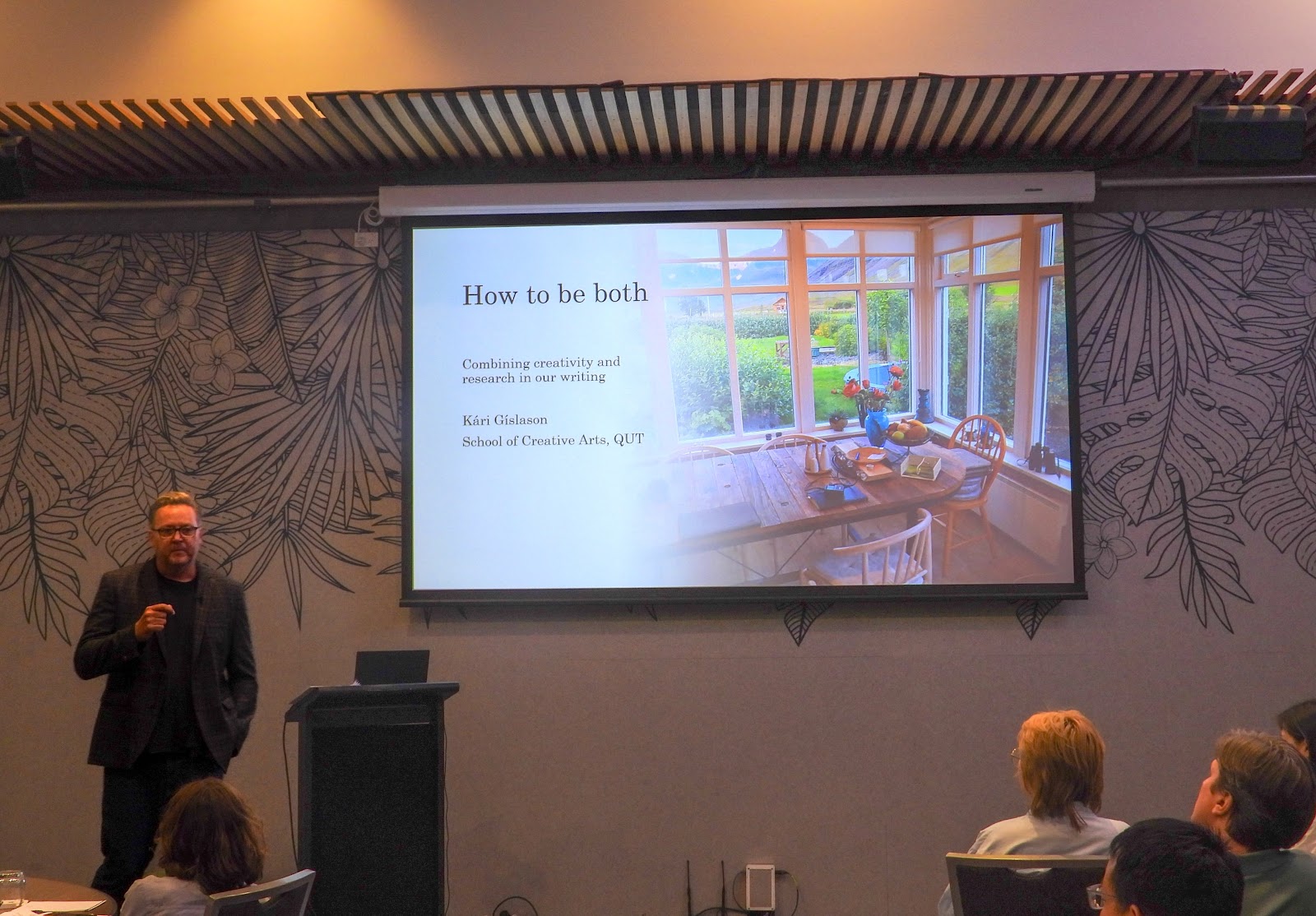
| Pic by Kári Gíslason |
are my feet in the way
(a blog by kári gíslason)
Thursday, September 24, 2026
Multilingualism on Screen: The case of "Everybody Loves Horses"
Tuesday, September 22, 2026
University towns
I recently visited Bologna, which lays claim to being one of the oldest universities in the world, and, by extension, one of the oldest university towns.
For me as an academic, such towns have an immediate appeal: their tone and bearing feels familiar and filled with calm, purposeful energy. Universities face many challenges at the moment, and the Humanities are frequently said to be under attack. At the same time, visiting university towns helps to remind me of longer timeframes and an enduring presence.
| Tübingen, Germany |
| Heidelberg, Germany |
Oxford, England |
| Halifax, Canada |
| Basel, Switzerland |
| Centre for Arts & Creativity, Banff, Canada |
| Bologna, Italy |
| Durham, England |
| Bangor, Wales |
Monday, September 7, 2026
Father-son travel memoirs
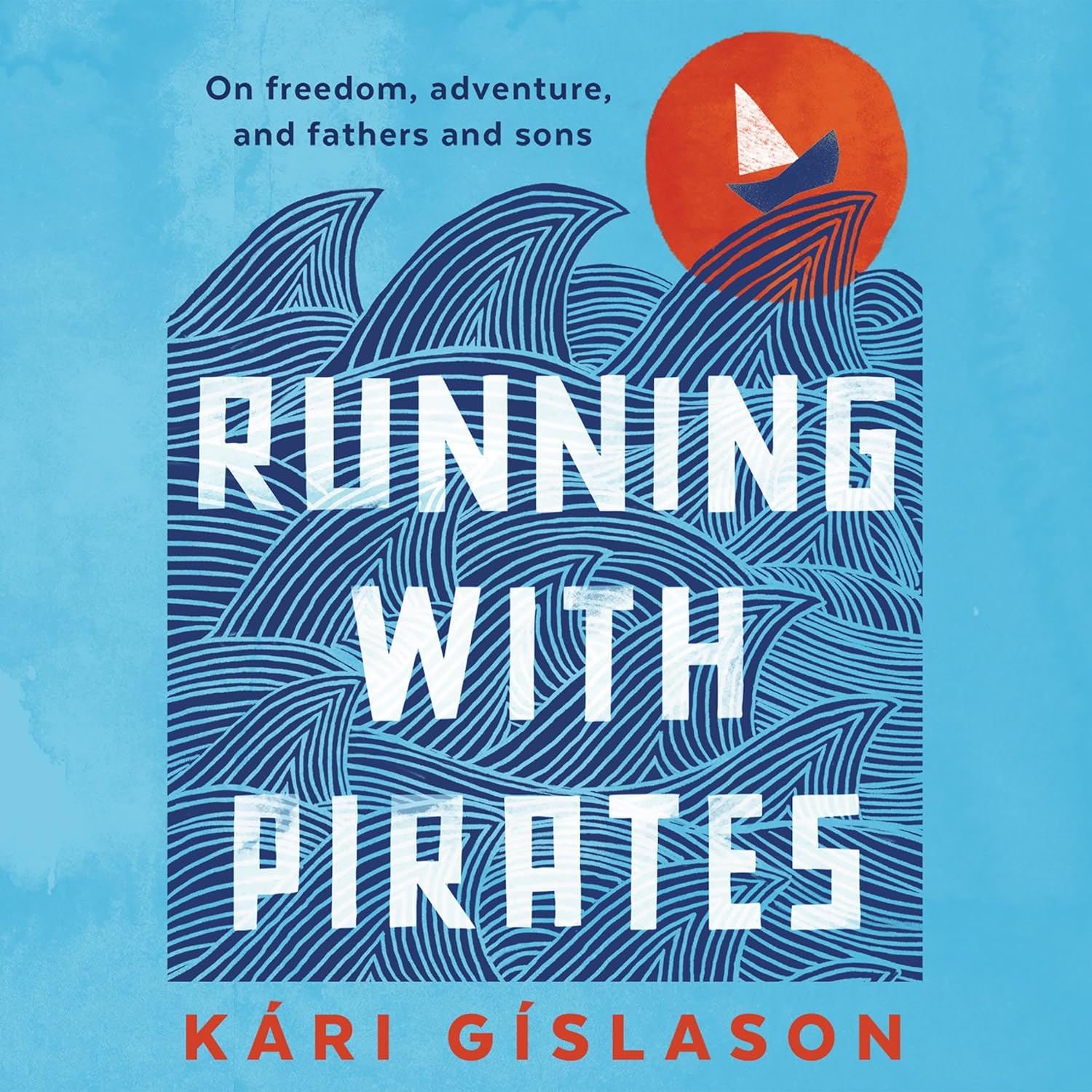
On Sunday 6 September 2026, I shared the stage at the Eumundi Writers Festival with my son Magnús and with author Simon Cleary and his son Dominic. The festival had invited Simon and me to talk about our 2024 titles, Everything is Water by Simon and Running with Pirates by me, both of which have accounts of travelling with our sons.
The panel traversed quite a few topics, including the nature of the travel projects themselves, as well as our sons' own recollections of them, that is, from their points of view rather than just from the writers' perspectives.
We also broached topics that re-occur frequently in discussions of creative nonfiction, and family memoirs in particular: how and when we might represent the lives and views of those who are close to us; how creative nonfiction interrogates broader social issues inductively; and, the role of writing as a form of thinking.
Inevitably, the panel also highlighted the changing nature of father-son relations across generations, especially the nature and extent of the involvement of fathers in parenting and how fathers communicate with their children. As a (live) work of nonfiction, it highlighted the potential for creative writing to speak with as well as about others.
| From left: Dominic and Simon Clearly, Magnús Gíslason and me (Picture supplied by Simon Cleary) |
Monday, August 31, 2026
Iceland and the wider world
Next week on our Viking Lives podcast, Richard and I will be telling the story of Iceland's conversion to Christianity in the year 1000 AD. This moment in the country's history is described in a number of medieval works, including several of the sagas and Íslendingabók (The Book of Icelanders) by Ari the Wise, an historical account that dates from 1130. As scholar Siân Grønlie has observed in her introduction to Ari's book, the conversion as we find it in Íslendingabók seems to witness a "resilient secularism" in how the change was approached and understood.
In the 990s, King Ólafur Tryggvason of Norway had been pressuring Iceland to convert. The king sent missionaries to Iceland and took Icelanders living in Norway into hostage and threatened to kill them if the country didn't adopt the new faith.
The question of whether to do so was taken up at the national parliament at Þingvellir. As the debate proceeded, and it began to look like there would be a battle on the assembly grounds, the news arrived that a volcanic eruption has started. The heathens proclaimed that the gods were showing their anger. Snorri goði, a chieftain from Helgafell on the Snæfellsnes peninsula (where there is, indeed, quite a lot of lava), pointed at the older lava fields near the parliament and asked, 'Then, at what were the gods angry when they created this?'
He asked the question as a way of supporting his case for Christianisation and neutralising the heathen's point, but it is one that also suggests a degree of scepticism about the role of divine figures in the lives of humans more generally. He seemed to have a level-headed view of change.
When the two sides of the debate couldn't agree on whether Iceland would become Christian or remain true to the old gods, the assembly asked the Law Speaker, Þorgeirr Ljósvetningagoði Þorkelsson, to make the decision on the country's behalf. Þorgeirr was himself a heathen, but after deliberating underneath his cloak for a day and a night, he announced that Iceland would, from then on, be a Christian country. The parliament accepted his decision, one that was about religion and at the same time about how Iceland responded to the changes in the wider world. It might join in the changes occurring elsewhere, it might not, but it would make decisions that expressed faith in its own systems and institutions: the parliament, a single unified legal code, and the office of the Law Speaker.
And also, perhaps sensibly, noting what the king of a more powerful neighbour though they should do.
A thousand years have passed since Iceland adopted Christianity, and as in other countries the role of the church has changed. Iceland was of course initially a Catholic country, but with the Reformation a Lutheran one, and it has a Constitution that guarantees religious freedom for all. Two hundred and sixty-odd years after King Óláfur got his way, Iceland became a Norwegian colony, later a Danish one, and in the twentieth century was able to reclaim full independence. The country sits rather apart and also over the North Atlantic ridge, and will always be pushed this way and that.
Over the past few weeks, I haven't heard much mention of the sagas or of Ari the Wise during the country's debate over whether to initiate talks with the European Union about future membership. Tying EU membership to the stories we find in medieval sagas would be a stretch, I know, even for a saga scholar. But from where I followed the debate as the No vote took the day, from far-away Australia, I noted some familiar-sounding predictions of social eruptions, fissures, and ruptures. I wondered if perhaps a little bit of Snorri goði was in order, his wry scepticism that has always struck me as being very Icelandic in its way.
| Þingvellir National Park, Iceland (pic: Kári Gíslason) |
Wednesday, August 12, 2026
Eumundi writers festival 2026
On 6 September 2026, which is Father's Day in Australia, my son Magnús and I will be participating in a special fathers-and-sons panel at the Eumundi Writers Festival on the Sunshine Coast, to discuss my recent memoir Running with Pirates, which is partly about raising sons and communication between children and parents.
On stage with us will be author Simon Cleary and his son Dominic, talking about Simon's book Everything is Water, which charts a remarkable walk that Simon, his son, and other friends and colleagues completed along the entirety of the Brisbane River.
More details are available here.
Monday, August 10, 2026
Meanjin editorial advisory panel
I have been appointed to the Meanjin editorial advisory panel.
Meanjin, which was founded by Clem Christensen in 1940, is one of Australia's best-known and most highly regarded literary journals. It was recently transferred from Melbourne University Publishing to the Queensland University of Technology.Thursday, July 16, 2026
Byron writers festival 2026
In August, I will be appearing at the Byron Writers Festival in three sessions:
Viking Lives: Ghost Stories, 8:15pm 14 August
Cultural Touchstones, 3pm 15 August
Migration Stories, 9am 16 August
For more details, please go to: https://www.byronwritersfestival.com/festival/writers/kari-gislason
Thursday, June 18, 2026
New book deal: To Catch a Fox
I'm excited to share the news that my new book, a crime novel set in Snæfellsnes, Iceland called To Catch a Fox, will be published by HarperCollins in August 2027!
Tuesday, May 12, 2026
Viking Lives series 2
Today is the launch date of series 2 of Viking Lives, a podcast that I am making with broadcaster and author Richard Fidler.
The podcast offers a history of the Viking Age through a series of individual biographies drawn from medieval sagas and chronicles.
Series 2 begins with the life of Harald Finehair, reputedly the first ruler of the unified kingdom Norway.
Available on Apple, Spotify, and other major podcasting platforms.
| Lindisfarne, pic by Kári Gíslason |
Sunday, May 3, 2026
Insta visual diary
Tuesday, February 10, 2026
Viking Lives podcast
Today is the launch date of Viking Lives, a new podcast series that I have made with Richard Fidler.
Viking Lives tells the story of the Viking Age through a chain of biographies of individuals who we know through the sagas and poems of the period.
The podcast is available on all the main platforms.
See also https://www.instagram.com/vikinglivespodcast
| At Lindisfarne with Richard Fidler |
Sunday, January 18, 2026
Edda House, Reykjavík
During my doctoral studies in Old Norse-Icelandic literature from 1999-2003, I spent a number of months undertaking research at the Árni Magnússon Institute in Reykjavík, during which time I was guided by Professors Vésteinn Ólason and Úlfar Bragason. The Institute is the home of Iceland's manuscripts, as well as of scholars, libraries, and a thriving community of those who have an interest in the sagas, including international guest scholars.
At the time, the Institute was located in Árnagarður, a building named after the same eighteenth-century scholar and manuscript collector who gave the Institute its name, and something of brick in appearance: a long, rectangular construction that nevertheless exhibits the charm of late-sixties minimalism, or the "International Style" that makes it a recognisable, familiar building for most who see it.
Some twenty years ago, plans were made for a new building dedicated to Icelandic language and culture. Ground was broken, and big hole was dug near the National Library, and then the plans were undone by the Global Financial Crisis of 2008, which hit Iceland particularly severely.
Many in the country bemoan the impacts of tourism, but undoubtedly one is that the economy recovered sufficiently well for the plans for building projects like this one to be revisited and revived. The result, Edda House, has now been in use for a couple of years and offers a spectacular, more expressive reply to the former home of the manuscripts.
I got to see it for the first time this week, during a visit to Reykjavík:
Friday, January 9, 2026
Emotions in Old Norse literature
The study of emotions in different historical periods has been a significant field of enquiry in the Humanities for a couple of decades, and has seen the publication of a growing number of papers and books about the topic in Old Norse studies, too. The workshop I attended was a very collaborative one that was used as a step towards the production of a new book of essays, coordinated and edited by Gareth Evans of St John's College, Oxford University and Brynja Þorgeirsdóttir from the University of Iceland. My chapter, on creative approaches to understanding emotions in Old Norse literature, will suggest ways we can adapt creative writing methods to generate new research questions in the area.
Wednesday, August 6, 2025
Upcoming workshops
This August, I am offering two workshops in the areas of creative nonfiction and the (somewhat more) hybrid form of autobiographically-informed fiction.
On Thursday 28 August, I will be giving an online workshop entitled 'From Memoir to Fiction' for Boroondara Libraries in Melbourne.Thursday, October 31, 2024
Combining creative and critical thinking in research
For me, the keynote represented an opportunity to further develop and share my ideas about how creative writing and other fields can be used together to tackle questions and topics that are difficult to approach through scientific or creative tools alone: where aspects of both are needed together. This is a growing area of methodological inquiry worldwide, and one I have explored in other contexts, too, such as in collaborations with medical practitioners in the field of Narrative Medicine, as well as in the use of storytelling techniques as a form of literary-historical study, particularly in the case of the medieval Icelandic sagas.
On Tuesday, the audience consisted of an international group of people working in innovative areas of natural science who, I sensed, were also very open to the idea of using creative writing tools and the different modes of thinking they enable.
| (Picture: Max Planck Queensland Centre) |
| (Picture: Max Planck Queensland Centre) |
Thursday, October 10, 2024
Sunshine Coast Hinterland Writers Festival
Saturday, October 5, 2024
Greek Herald feature
Tuesday, October 1, 2024
New Reviews
Writing for Good Reading Magazine, Helen Gildfind comments,
Running with Pirates is an elegantly crafted and finely detailed memoir in which Gíslason recounts his trips to Corfu as a vulnerable teen and, decades later, as a father. The book is carefully structured via parallel narratives that express and exploit memoir’s inherent interest in the tension between the storied past and the remembering present.
Meanwhile, Schooldays Magazine observes,
This memoir of an adventure at the age of eighteen really does have it all...This is an enjoyable memoir for all to read, unputdownable. It is also one that anyone whose teens are planning on taking a gap year, or adults planning one, should read. It is also good reading for parents developing harmonious relationships with their teens.
| Corfu Town Harbour, September 2014 |
Wednesday, September 25, 2024
Audiobook of Running with Pirates
The audiobook version of my new book, Running with Pirates, will be published by Ulverscroft on 1 October 2024.
I have done the narration of the audiobook myself, the second time I've recorded one of my works, the other when I read my sections of a book I co-authored with Richard Fidler, Saga Land, in 2017.
I tend to read back to myself while I write, as I find this helps in crafting the rhythm and pace of sentences, and in checking for sense and clarity, as well as for grammatical errors. But to record an entire story in a series of sittings is quite a different experience: it seems like a new composition is being created, not entirely performative, nor solely textual.
In the case of Running with Pirates, which has two narrative strands, I wanted to read each strand in a way that reflected their distinct tones: a fable-like tale from thirty years ago that is being punctuated by a contemporary account that is more like a travelogue, written in the present tense and responsive whatever is happening in the moment.
The audiobook can be purchased through online retailers, such as Amazon here.
Saturday, September 21, 2024
Review of Loot (on The Bookshelf)
I've been interviewed on ABC Radio National's 'The Bookshelf' about Tania James's new novel, Loot.
Loot is an historical novel set in the late 18th and early 19th centuries, in India, France and England. I was invited to speak about the novel, because it includes a portrait of a friendship between a young, rather unsure man of 17 and an older, weary master craftsman, a type of relationship that forms something of a connection between the novel and the characters of my most recent book, Running with Pirates. The two books also share themes theft and piracy, debt, and returning.
The interview/review is available in full here.
Sunday, September 1, 2024
Busy Running
The last few days have been busy ones for Running with Pirates, if, that is, one can speak of a book being 'busy'. Perhaps it's more accurate to say that I've been doing a lot.
On Tuesday, I flew to Sydney to be on ABC Conversations, and followed that interview with a wonderful evening event at Roaring Stories Bookshop in partnership with Red Mill Distillery, Rozelle, a stunning venue for a book talk.
Over the following days, I visited quite a number of bookshops in Sydney, to talk to booksellers and sign copies of the book. The photos below were taken at Dymock's city store in George Street.
When I got back to Brisbane, I gave a talk to a very engaged audience at Wynnum Library, who had lots of questions about writing memoir, comments about retaining one's sense of adventure, and thoughts about travel and parenting more generally.
Today and yesterday, two short travel pieces that I've written that are connected to the story have been published in the weekend papers, one in the Weekend Australian Magazine, the other in the Escape lift-out of the News Corp Sunday papers.
Along the way, two new reviews of the book have also appeared. Writing for ABC News's 'The Best New Books Released in August', Nicola Heath comments,
While Corfu provides a picturesque setting — with its rustic villages, olive groves and "bays that cupped water clearer than the sky" — this is a memoir about fathers and sons. As a father, Gíslason is thoughtful and attentive — if a little over-protective, he admits — and explores this territory with curiosity, sincerity and sensitivity.
Meanwhile, in Australian Book Review, Shannon Burns has offered a somewhat less favourable response that questions whether enough happens in the book, but which also notes that it 'evokes a strong sense of place and is wonderfully attuned to the sensitivities of early adulthood.'
| Source: ABC News |
Thursday, August 29, 2024
ABC Conversations interview
I've been interviewed about Running with Pirates by Richard Fidler for ABC Conversations, which is the Australian national broadcaster's highest ranking podcast.
Richard's interview focussed on the pirate strand of the story, or the events that happened in 1990, when I visited Corfu for the first time.
The interview is available in full here.
| Angelokastro, Corfu |
Sunday, August 25, 2024
Roaring Stories event
I hope you can join us. Tickets for the event are available here.