Showing posts with label The Promise of Iceland. Show all posts

Thursday, February 4, 2016

Pictures that ask the right questions

Last week, I published this short piece in the Queensland Writer's Centre magazine, WQ, about photographs and memoir.

*

I expect many people begin the writing of a memoir by looking through old photos. Pictures, after all, belong in the past, and they hold out the promise of delivering it to us again: everyone is younger, surrounded by yesterday’s world, a moment fixed in time. Even the size of the photo paper and printing tone belong back there, in a printer’s shop that doesn’t exist anymore. And yet, for the purpose of writing a memoir, the most useful pictures also reach beyond the past, and beyond their initial role in verifying your memories, or filling out the details. That is, they are more than an account. Such pictures seem to be asking questions about what happened next, in the moments and years after they were taken.

This is a photograph of my mother Susan, taken in 1956 when she was fifteen. She’s standing on the right, with her arms crossed. It looks like she’s watching something that’s happening out of frame, and her friend is also distracted. She’s heading over to talk to someone, an off-screen presence that you imagine laughing along with the girls.

I’ve always loved the picture, even before I wanted to write about it, or the events around it. I’m drawn to the distracted happiness in it, but also the slightly melancholy sense that, whatever’s going on, seems to be coming to end – the party’s breaking up, and the girls are heading back to their own groups.

I began to learn more about the photo when I started writing a family memoir, and asked Mum to tell me what was happening in it. It turned out that it records a moment, sixty years ago, when she and her family crossed the equator on a passenger ship. What we’re seeing is the final moments of a ‘line crossing ceremony’, or a party held to celebrate the fact that their ship was now in the southern hemisphere. You can’t see him, but apparently a figure dressed as Neptune is hosing them all down.

Mum said the family was travelling from England to Australia, but also this: the photo was taken during the third time she crossed the equator. For, the family had in fact made an earlier migration, one that had largely failed and seen them return to England. Now, a year on, they were trying it all over again – having another go at living on the other side of the world.

Line crossing ceremony. To me, the phrase, like the picture, belongs to a different era altogether, when travel was much slower, slow enough for that extraordinary line crossing to be given its proper ceremony. As it should be, really. The whole ship could take part, get a soaking from Neptune. But perhaps the most powerful ceremonies were internal and familial. Or, at least, that’s how I began to think about the picture now, when I talked about it with Mum.

What, I wondered, was my mother feeling in that moment? What lay behind that distracted, giddy expression that she wore in the photo? Just fun, or something more at the heart of her character, and her openness to change and adventure? Whatever it was, I had the suspicion that she’d been chasing it ever since. That she kept looking for it in her adult life, during the years of travelling that followed and eventually took her back to England, and then Iceland, and then to Australia again.

I wondered whether there was something present in that line crossing ceremony that I might find in other photos, and in other crossings that she’d made and even photographed, eventually also with me.

One photo. The family memoir that I ended up writing, The Promise of Iceland, was full of such questions, really – much more so than answers. Often they were prompted by pictures that seemed less like portraits of the past than enigmas and riddles. But then memoirs, too, are often structured around questions and reflections rather than answers. Like pictures, the most valuable ones not necessarily those that offer up the past, but rather the ones that help us ask the questions we need to ask.


Tuesday, September 1, 2015

Viking Ancestors

'On Meeting Your Viking Ancestors', a Curiosity Lecture that I gave at this year's Sydney Writers Festival, is now available as a free podcast on the Festival's iTunes channel here.


Monday, April 8, 2013

Top 40 Book Club Reads


Brisbane City Council libraries have published their annual Top 40 Book Club Reads, a catalogue of book titles that "help book clubs with their reading selections. Ranging from new releases to classics, it includes both fiction and non-fiction".

My memoir The Promise of Iceland has been included among the non-fiction works. More details available here.


Wednesday, October 3, 2012

Tony's Reading List Review

An interesting review of my memoir The Promise of Iceland in part comparing my work with another recent book about Iceland has appeared in Tony's Reading List.

The reviewer writes that the book is "a compelling narrative" that provides "a welcome insight into Icelandic culture". After outlining some of the main ideas and events in my story, he concludes: "All of which makes The Promise of Iceland an excellent work. Well written, fascinating and absorbing, the book pulls the reader along on Kári's search for closure and fulfilment."

The review is available in full here.


Other reviews of The Promise of Iceland can be found here. The book is available for sale at the usual online outlets. A recent review by Cath MacAdam on the book's Amazon.com page reads:

A very touching story, how a promise made long ago has enduring consequences.Kari shares so much, from his love for his mother to the confusion of growing up without getting to know his father. This will resonate with many of us who grew up in fractured families, for whom the place we call home is never quite enough but no other place really feels quite right either. Kari's decision to break the promise of silence and contact his father's family would have taken great courage, and so was the decision to share his story with the world. Yet it's not a sad story, rather a story of strength, love and hope, and there are moments of wry humour. Reading Kari's story made me reassess some of the decisions I have made as an adult and a parent. How our choices, which may seem inevitable at the time, have such long lasting effects on the lives of those we love the most. Many times throughout the book I actually forgot this was a real story and not fiction. The writing transported me to a small, frozen community where reputation means so much. Yet the people who inhabit that world showed much warmth and generosity of spirit. A great read.

Monday, September 10, 2012

Radio 4BC Interview

On 31 August I was interviewed by Greg Cary and Gina Baker on Brisbane's Radio 4BC. The interview, which was on the subject of my book The Promise of Iceland, is available in full here.


Reykjavik from the old hot water tanks

Sunday, September 9, 2012

The Promise of Iceland ebook edition

My memoir The Promise of Iceland is now available as an ebook through online distributors, including through the Avid Reader bookshop here.


Ísafjördur (2005)


Friday, July 27, 2012

Queensland Book of the Year Shortlist

I'm delighted to announce that The Promise of Iceland has been shortlisted for The Courier-Mail People's Choice Queensland Book of the Year award.

The other shortlisted books are Closer to Stone by Simon Cleary, The Fix by Nick Earls, The Ottoman Hotel by Chris Currie (which I earlier reviewed here), Riding the Trains in Japan by Patrick Holland, and Worse Things Happen at Sea by William McInnes and Sarah Watts.

More details are available on The Courier-Mail's website here. You can vote for your favourite book here.

With Simon Cleary (centre) and Chris Currie (right). Picture by Steve Pohlner, The Courier-Mail.


Friday, June 1, 2012

Writing Bar Review

Andrea Baldwin's review of The Promise of Iceland has appeared in Writing Bar, the blog of the Sydney Writers' Centre. Andrea writes:

What stands out for me about this book is the narrative voice. It’s honest, conscientious and, almost to the end, somewhat bewildered. It creates a saga-like feel: the hero is on a difficult quest with which onlookers, however sympathetic, cannot help because he has to do it himself. You feel like cheering when he succeeds.


The review is available in full here.


(Pictures by Kári Bergsson)

Monday, May 7, 2012

Stilts Review


Krysi Egan's review of The Promise of Iceland has appeared in Stilts. The review, which is available in full here, includes:

With elegance and tenderness, Kari discusses the loves that have defined his life; the love for his intriguing and adventurous mother, the secret and silent love for his father, and the love and longing for Iceland. While painting a spectacularly vivid portrait of the natural beauties of Iceland and its people, Kari explores the complicated nature of how people fall in love, the promises they make, and the reality of what happens when those promises fall apart.

All of those things make this a fabulous memoir, but what makes it unforgettable is the tremendous respect and grace in which Kari tells a story that is only in part his to tell. His sensitive portrayal of his mother as he shares the most intimate and defining moments of his family history is truly a wonder. Whilst a measure of bitterness towards his father would be justifiable and easily forgiven, Kari leaves it off the page, instead focusing on the delicate nature of the circumstances and the ultimate search for belonging.

Wise and unassuming, humorous and remarkably affecting all at the same time, The Promise of Iceland is an enchanting reflection of a fascinating life and a profound exploration of the human condition.


My mother, Susan Reid, on The Esja (1971) 


Saturday, March 24, 2012

Craft: Structure & Meaning in Memoir

The Oxford Dictionary of Literary Terms defines memoir as:

A narrative recollection of the writer's earlier experiences, especially those involving unusual people, places, or events. A memoir is commonly distinguished from an autobiography by its greater emphasis on other people or upon events ...and sometimes by its more episodic structure, which does not need to be tied to the personal development of the narrator.

I'd like to expand on this description of memoir by looking at the structure of my own.

The Promise of Iceland is, in something like the way the definition suggests, as much about 'other people and events' as it is about me. Specifically, I wanted to write about Iceland and my parents, even if I did so through myself, that is, even if my imagining of Iceland was the link between my parents and the country where they met.

I also wanted to write on the theme of home. While the book is by nature more narrative than it is argument, and so couldn't in any sense be called an extended personal essay, I nevertheless hoped that the broader questions behind the work would be clear to readers and would frame the personal within the universal: how do we conceive of home, and what role do our parents play in our conception of home as a place or as an idea?

One way of attempting a broader framing is through structure, a technique that can be used as an alternative to the episodic or theme-based approach of memoirs that function more clearly as personal essays, such as for instance The Year of Magical Thinking by Joan Didion, a book that I love and that I teach in one of my undergraduate courses. Didion tells the reader in explicit terms what it is that she's trying to work out - how is our thinking affected by grief - and then comes at the question from a number of angles, each of which is given a chapter that, in a subtle way, marks the progress of her first year of loss.

Yet there is implicit meaning in the Didion as well, in particular around a barely acknowledged dialogue that she is having with her deceased husband John, as part of the progress of writing the book. The first fifty pages or so deal not only with the link between the ordinary and the suddenness of change, but also perform that very change in the structure of the narrative: on the first page we are told of John's death, and so are quite prepared for it, and yet by the end of the first section we're also shocked, as though, like Didion, we didn't really think it could happen, or even has happened. That is, the form not only reflects but in a sense enacts the content.

Given chronologically, the main events in The Promise of Iceland run as follows:

1941: My mother's birth    
1951: My mother's family moves from England to Australia, and then back to England
1956: The family moves to Australia a second time
1957: My mother's parents separate
1961: My mother marries Ed
1969: My mother and Ed separate
1970/71: My mother moves to Iceland and meets my father
1971: My mother falls pregnant; the father is married and she promises not to reveal his identity
1972: I am born, in Iceland
1977: My mother and I move to Sydney
1979: We move back to Iceland and I meet my father for the first time
1982: We move to England, where I attend boarding school
1986: We move to Brisbane, where I finish school
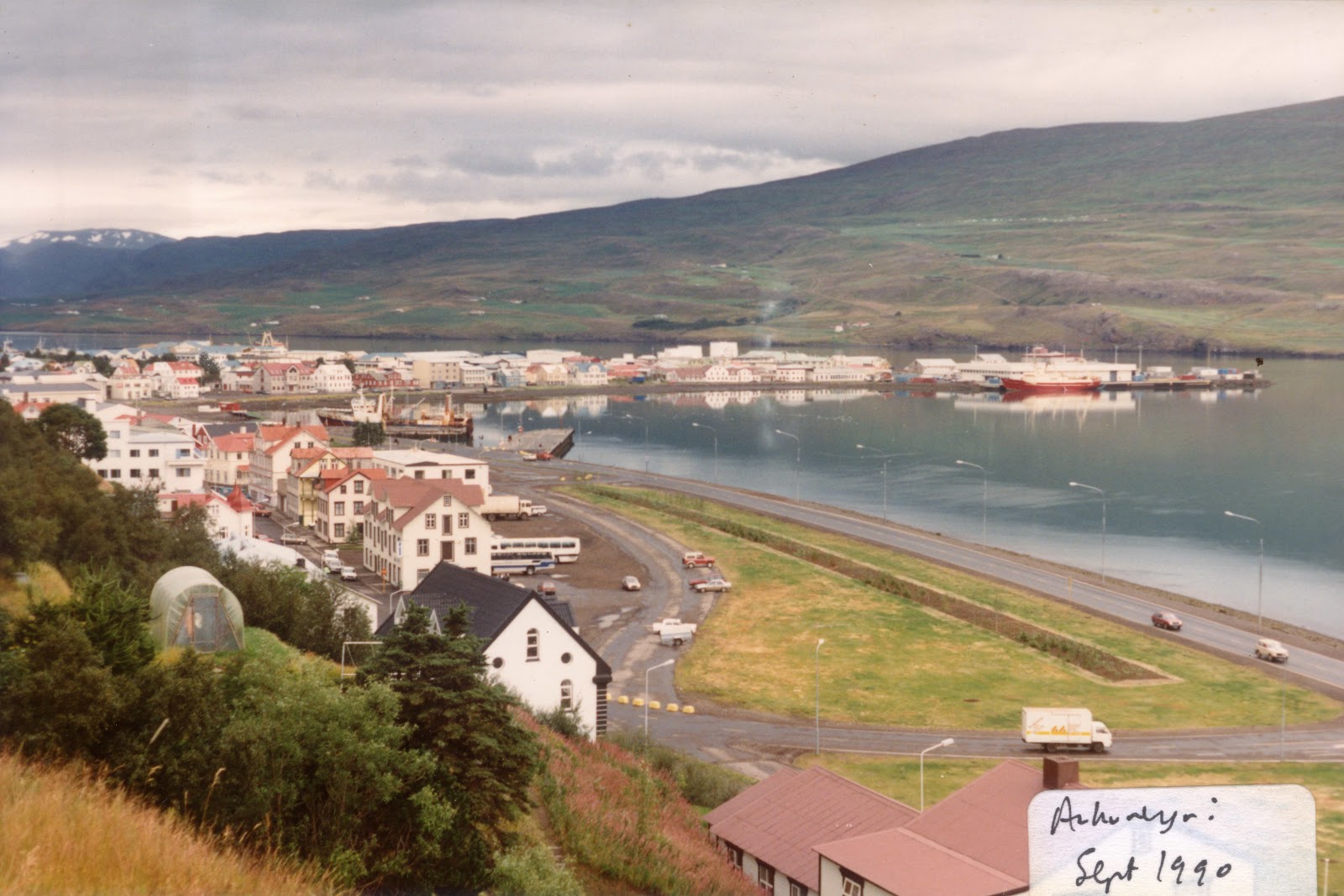
1990: I visit Iceland and, at my father's request, promise that I will also keep safe the secret of his identity
1990-1999: University years, during which I begin a PhD in Icelandic Literature
1999: I visit Iceland and decide to break the promise I made nine years earlier, and so meet my siblings for the first time
2001: I visit Iceland for six months and decide I would like to live there again
2004: I marry and move to Iceland with my wife
2006: Our first child, Finnur, is born in Iceland
2007: We return to Brisbane
2010: My last visit to Iceland, for a family wedding
2011: My father dies

In structuring this story for meaning, I hoped to relate my experiences to a number of ideas:

  • returning to place as returning to the past,
  • family stories as patterns, and home as a kind of story, 
  • the idea of home as related to notions of origin and parenting.

The result was the following order of events:

Click to enlarge

Thus, the memoir begins with a Prologue set in 1990 when, aged 17, I meet my father and repeat a promise that my mother had made nearly twenty years before, not to reveal his identity. The story then moves to 1977, or to the first point when my mother and I have, in a sense, an equal share in the story. So, while being a big jump back in time, I hope it is a natural step in the story established in the Prologue, that is, on the topic of the shared nature of a promise we made to my father. 

After the idea of the promise has been established, both in terms of my own decision as a seventeen year old and in terms how my decision was influenced by my mother, the story moves back further still, to 1941 and my mother's childhood and early life in England and Australia. From there, it narrates how after her marriage to Ed ended she found herself in Iceland, and how she met my father there . Naturally, my intention at this point was to try to catch a full sense of who she was when she fell in love and then fell pregnant. This, I felt, was the necessary context for her decision to protect my father, and my subsequent decision to do so as well.

Chapter 4, 'Paper Run', reintroduces my part as the central strand: I return to the story as a young boy visiting my father. Chapter 5 returns to my mother's story, to 1972 when she gave birth to me. The aim so far has been to link our stories, and through interweaving bring up ideas around the theme of inheritance: secrets, family promises, and a complicated sense of home.

A straight chronological order from chapter 6 onwards reflects that the story is now located almost entirely in my experiences rather than in the drawing of parallels. That is, memoir now moves backwards and forwards along a theme of physical return to Iceland as a way of thinking about our returns to the past. 

The climax of that process comes in September 1999, which is why four chapters are spent in the company of that month. An extended narrative of the outcome of that visit to Iceland occupies chapters 16-20, and culminates in the birth my oldest son, Finnur. The work ends in 2011, with the deaths of my father and my mother's husband Ed. These events, along with my most recent journey to Iceland in July 2010, are given as a closing bracket to the left parenthesis of the Prologue. 

A wider perspective might reveal the following tripartite structure, again bracketed by the Prologue (1990) and the Coda 'Ashes' (2011): 

A) My mother's journey to Iceland (1941-1972) and my childhood and youth (1972-1990) up to the point where we again meet the events of Prologue (1990), when I made the promise to my father;
b) My life after I made the promise until the point when I decided to break it (1990-1999); and
c) Returns I made to Iceland after I'd broken the promise (2000-2010).

In this description of the memoir, the movement in the narrative is essentially one that alternates between  childhood and parenthood, and how these two roles connect around the idea of home. Just as we can choose to become parents - and after which point we're never really our parents' children in quite the same way - so too at some point we must make our own decision about home. Claiming home, and the sense of belonging that comes with it, is part of a  a more mature conception of our parents, one which brings with it a new kind of curiosity about them and, of course, their stories.

Click to enlarge


Monday, December 12, 2011

The Pictures of Iceland

One of the most gratifying things to come out of publishing my memoir has been the very positive response that readers have had to my mother's characterization. Many think of hers as the dominant story, or the conversation between her and me that the memoir implies as the work's central dialogue.

I think that's right. And, for my part, I think that the conversation we are having is about how we have gone about defining the nature of home, both individually and together. It's something we've both fought to recover from a basic family impulse that home is always off in the distance somewhere. At its core, The Promise of Iceland is an attempt to represent a lifelong journey, it is a traveller's account of discovering belonging -- or a sense of belonging that I have long been convinced was a continuation of my parents' and grandparents' journeys home.

Naturally, readers would like to know more about her, and one of the first questions I'm asked is, how does she feel about the book now that it's out? If I was altogether sure of the answer to that question, I would give it. What I can say is that she read the final draft before it was published and let me off with a couple of minor corrections. For example, I had her rate of shorthand words per minute mixed up with her typing speed.

But readers also want to know more about how she looked. Perhaps I should have said more about that in the book, but a few months on from publication I'm sure it's okay to supplement the description here, with a mini photo essay.


This picture is taken on The Esja, a ship that would circumnavigate Iceland and take on a handful of paying passengers. Thus my mother came to understand the country as it seen from the sea, and very much fell in love.


I believe this one's from August 1972, a month before I was born.


My first home, a basement apartment in Sólvallagata that my mother moved into when she first arrived in Iceland in December 1970. On the wall, line drawings that her ex-husband Ed did while he was visiting. I just love those chairs.


A couple of early portraits, one taken by a friend, the second a studio picture.


My favourite of Mum and me together, and also here Mildred, my maternal grandmother who features in one of the opening chapters of the memoir. We are on an early visit to Melbourne, I believe.


And as the sticker says, Sydney 1977, aged 5 and just moved from Reykjavík to Mosman. (Just so everyone knows I haven't changed much.)


Friday, November 25, 2011

A Neighbourly Review

My colleague at QUT Lee McGowan has given a very personal review of The Promise of Iceland on his blog The Simplest Game.

Lee suffers from something akin to my own northern nostalgia, in his case for his homeland Scotland. His review is available here.

An earlier postcard from Stirling that Lee wrote for Are My Feet In The Way can be found here.


Thursday, November 24, 2011

Femail review

Brooke Hunter's interview with me and review of The Promise of Iceland has appeared in femail.com.au. A full version is available here.


Friday, November 18, 2011

Review from FNQ

Bev Blaauw's review of The Promise of Iceland has appeared in The Cairns Post. Her review includes these comments:

Kari’s descriptions of Iceland are so beautiful that one is tempted to pack up and go there. He makes the long, dark winters sound just as enticing as the extraordinary Northern Lights. Each time Kari returns to Iceland he finds new ways of viewing life.

Finally, Kari meets his family, stops blaming his father and learns to live as an Icelander in Iceland, before returning to Brisbane to write so eloquently about his other home.


Verdict : Adventure, history, family, love and sheer bliss.

The full review is available here.


Friday, September 30, 2011

Three reviews


Reviews of The Promise of Iceland have appeared in the Sydney Sun Herald, The Gold Coast Bulletin, and The Toowoomba Chronicle. Reviewers' comments include:

"There are cycles within families, patterns in the generations, and there is a definite feeling of restlessness and uncertainty within mine," says Gislason..."There is also the business of inheritance, of asking what you are comprised of, and of finding ways through the chapters and secrets of your own story."
That story begins in 1970 with an ad in London's The Times newspaper for an English-speaking secretary. Gislason's mother answered the ad, secured employment among Iceland's Army of Foreign Secretaries and soon after found the arms of her secret lover.
Gislason retraces her steps and then his own over the years, taking this moving family saga from Iceland to England, Sydney to Brisbane, as all the time the weight of his secret becomes heavier.
"People who share secrets become confederates of a kind and I suppose that's what I had with my father and my mother," he says.
"It was a bond, but it was also an absence and something of a burden which, as time progressed, was stopping me from doing other things.
"I had to face my own story to truly understand myself and my parents and I hope the book will also allow people to understand my parents from their point of view."
The Promise of Iceland does allow that understanding.
It is an honest, contemplative and heartfelt journey across generations, landscapes and, appropriately for a land such as Iceland, the truth and mythology of family.


(Michael Jacobson in The Gold Coast Bulletin, 27 August 2011, p. 18)


*

THIS is a beautifully told journey by a man who was tracing his roots and discovering himself.The author was named after a character from one of the Icelandic sagas. He has written a doctoral thesis on concepts of authorship in medieval Iceland and currently lives in Brisbane. All his worlds have converged and this is his story about the directions and influences that empowered this. ... All the characters in his life are sincerely and perceptively portrayed and you will feel you know them all personally. The geographical and cultural details are illustrative and profound and this makes it all feel familiar.


(F. J. O'Dwyer in The Toowoomba Chronicle, 20 August 2011, p. 11)

*

Whether home is just the place we're born or a feeling we carry no matter where we end up, the age-old question remains: once you leave, can you ever go back? What if the decision to leave was not your own? Gislason's measured yet satisfying memoir charts his lifelong search for identity after leaving behind his birthplace of Iceland.

(Meredith Tate in the 'Extra' lift-out, Sun Herald, 18 September 2011, p. 6)


Monday, September 12, 2011

Sunday Mail 'Book of the Week'

The Promise of Iceland is the Brisbane Sunday Mail's 'book of the week'. Paul Donoghue writes, 'What could be a study in self-indulgence is instead a deeply charming account of displacement, of not really knowing where you come from and how that makes it difficult to know where you belong.'

(from the 'U on Sunday' lift-out in Sunday Mail (Brisbane), 11/9/11, p. 41)


Friday, September 9, 2011

In Conversation with Richard Fidler and Anita Shreve


On Thursday 8 September I was interviewed alongside the American novelist Anita Shreve for Richard Fidler's Conversations show on ABC radio. A podcast of the interview is available here.


Anita Shreve and Kari Gislason

With Anita Shreve (photo by Ursula Skjonnemand)


Hlídarendi

Tuesday, September 6, 2011

Adelaide Advertiser and Sunday Times (Perth) reviews

Reviews of The Promise of Iceland have appeared in the Adelaide Advertiser and the Perth Sunday Times. The former, by Penelope Debelle, includes this comment:

Icelanders love their country so much they are homesick even when they are there. The sub-Arctic landscape exerts an almost irresistible pull on Kari Gislason, who was born in Iceland but grew up in Australia...Kari's story of repeated trips to Iceland, his career as an academic specialising in Nordic sagas, and his final meeting with his extended family of half brothers and sisters is a powerful memoir about landscape and identity.

(from the 'Weekend' lift-out in the Adelaide Advertiser, 3/9/11, p. 29)

*

The piece in the Perth Sunday Times (by Brisbane-based reviews editor Fran Metcalf) is in the form of an interview and extended summary of the book, and describes The Promise of Iceland as 'compelling' (see the 'Weekend' lift-out of the Sunday Times, 4/9/11, p. 19).

Wednesday, August 31, 2011

The Age review

The Promise of Iceland is 'pick of the week' in Fiona Capp's review section in Saturday's The Age. Fiona describes the work in this way:

Few countries are further apart than Iceland and Australia. Central to Kari Gislason's story is the secret of his paternity. His married Icelandic father insisted his British-Australian mother (with whom he had a seven-year affair) keep Gislason and the relationship a secret. Gislason spent his early years in Iceland before his mother went back to Australia. The Promise of Iceland is not only about Gislason's return to Iceland to meet his father but also about the search for, and meaning of, home. It dawns on Gislason that his father is inseparable from the stark landscape of Iceland. "The interior was only ever a feared and dangerous place - something like my father, I thought, and the mysteries of his interior life." However, it is Gislason's portrait of his mother, Susan - her restlessness, her shyness, her dreams of elsewhere and her life in Iceland - that forms the spine of the memorable, finely crafted book.

(from the "Life and Style" lift-out in The Saturday Age, 27/8/11, p. 30)

Monday, August 15, 2011

Canberra Times review

Sara Dowse's review of The Promise of Iceland has appeared in the Canberra Times. Her very interesting (and, he boasts, positive) review ties the book to public discourses around parenting and privacy laws. She continues,

The Promise of Iceland is, in effect, that of Gislason's three strong formative loves. The first is his mother, an intriguingly complex and adventurous woman whom her son attempts to fathom with tremendous sensitivity and respect. Susan Reid (she was married before her liaison and kept her husband's name) had a passion for travel and, ultimately, Iceland became her dreamland. What Gislason does particularly well is make a case for the significance of place in people's lives, and indeed, his mother's love for the beauty of Iceland and the tight-knit community of its stoic, hard-drinking people is ultimately mirrored in his own. And further, Iceland's pull on him is bound up with his seemingly unrequited love for his father.


[...]


It's not usual for me to give the bones of a plot to readers--it's generally bad reviewing and spoils things for the reader. I've relented in this case because the plot is not really the meat of this narrative, which is how a young boy who's been raised in somewhat extraordinary circumstances grows into a highly perceptive and self-aware man, courageous enough to break the taboo surrounding his birth. What it illustrates clearly is the powerful need children have in most cases for the love of both their parents, and the necessity of loving them regardless of whether that love is judged by others to be undeserved. The journeys to Iceland, then, a country beautifully realised in the book's pages, are truly stations on the author's bumpy, if often amusing, road to healing and self-knowledge.


(from the "Panorama" lift-out in the Canberra Times, 13/8/11, p. 26)