Showing posts with label Great Journeys. Show all posts

Sunday, April 7, 2024

Great Journeys: How To Knit A Human

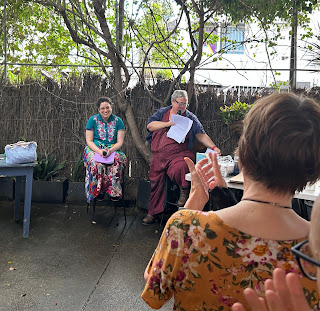
This afternoon, I attended the launch of How To Knit A Human by Anna Jacobson, a memoir about mental illness and recovery, as well as of a remarkable voyage in discovering lost parts of oneself. 

Some years ago, Anna suffered a period of psychosis that left her with large gaps in her memory. How To Knit A Human charts her attempts to reclaim some of those memories, or at least understand their loss, and to 'knit' together a sense of personhood through artistic projects such as writing, drawing, and photography. 

The book is itself part of the knitting of the self that she performs and reflects upon.

Anna's book formed the creative component of a doctorate in Creative Writing that she undertook with my supervision, and there was added pleasure for me today in seeing one of my students publishing her work to a wide audience. The book was launched at Avid Reader Bookshop in West End, with fellow writer Kris Kneen giving an insightful and warm speech to accompany its way into the world. It was also recently reviewed very favourably by The Guardian newspaper here.

Anna Jacobson (left) and Kris Kneen at Avid Reader Bookshop


Friday, September 2, 2011

Great Journeys: Graham Greene in Mexico


"People are made by places." (The Lawless Roads, p. 16)

The Lawless Roads (1939) by Graham Greene inspired Paul Theroux to observe that it's often the most difficult journeys that make the best travel books. Greene's journey was both of these things: an awful trip and a complex and ultimately brilliant work of non-fiction.

Greene got very ill. The means of transport was often terrible. He couldn't stand Mexico or for that matter the Mexicans whom he encountered. He got stuck with those Mexicans often. And when he finally reached the end of his trip it was to the news from his solicitor that he had been sued for libel over comments he'd made about Shirley Temple. He had every reason to grumble, and quite often in The Lawless Roads he does.

But it is a more profound type of difficulty that makes the book and the journey it represents great, and perhaps without this added dimension Greene's grumbling about the locals, their food, and the difficulties of the terrain could annoy. He had been sent to Mexico by the Vatican to report on the situation of Catholics, who had suffered under the rule of Plutarco Elisa Calles. Greene found plenty of evidence that the worst reports of killings, imprisonment, and other punishments were true. As a result, the author's depressed state as a traveller is in fact a rather light face for him to present as a social and religious commentator. His complaints about having to endure yet another terrible meal become a way of interrupting the much more dispiriting contemplation of a government that has become very cruel to its own people.

Out of that contemplation came Greene's landmark The Power and the Glory (1939), one of Time magazine's all time 100 novels. In fact, we first meet that novel's famous 'whiskey priest' of Tabasco in The Lawless Roads, and the two books share many questions, in particular how religious convictions exist and develop when there is a concerted and prolonged attempt to suppress them or replace them with new ways. The difficulties of the 'lawless road' were, in the end, illuminating ones for Greene, and his Christian convictions were much strengthened by the experience of seeing Mexicans maintaining theirs. The difficulties of travel may, in the end, have been fairly trivial. He made it back, and no doubt recovered well enough to enjoy even English food.

But the difficulties that came out of his journey were great. The worst journeys make the best travel books, because they are the ones that stay with you.

"I began to have a dim conception of the appalling mysteries of love
moving through a ravaged world." (The Lawless Road, p. 14)


Monday, May 30, 2011

Great Journeys: Elizabeth David wants an omelette and a glass of wine

I'm not sure you can do justice to the eclecticism of Elizabeth David's food/travel writing, or its mild disdain of all manner of poor taste, without simply collecting some of her prose ingredients. The following are all taken from her collection of newspaper and magazine articles gathered under the title An Omelette and a Glass of Wine.

August rain swishes down on the leaves of the wild jungly tree which grows, rootless apparently, in the twelve inch strip of gravel outside my London kitchen. I am assured by a gardener that the plant originated in Kamchatka, but now it looks more like something transplanted from the Orinoco. Staring out at it, hunched into her bumble-bee-in-a-black-mood attitude, my cat suddenly jumps up, presses her face to the window, doesn't like what she sees, comes back, wheels around, washes her face, re-settles herself on her blanket, stares out again. I feel restless too. ("Summer Holidays", 1962)

*

Cherished in our dreams, held close to our hearts in deathless legend is the humble French restaurant, the unpretentious petit coin pas cher where one may drop in at any time and be sure always of a friendly welcome, a well-cooked omelette, a good salad, a glass of honest wine. ("Secrets", 1963)

*

What on earth comes over wine waiters when they take the orders of a woman entertaining another woman in a restaurant? ("Ladies' Haves", 1962)

*

Once upon a time there was a celebrated restaurant called the Hôtel de la Tête d'Or on the Mont-St-Michel just off the coast of Normandy. The reputation of this house was built upon one single menu which was served day in day out for year after year. It consisted of an omelette, ham, a fried sole, pré-salé lamb cutlets with potatoes, a roast chicken and salad, and a dessert. Cider and butter were put upon the table and were thrown in with the price of the meal, which was two francs fifty in pre-1914 currency. 

...

As to the omelette itself, it seems to me to be a confection which demands the most straightforward approach. What one wants is the taste of fresh eggs and the fresh butter and, visually, a soft bright golden roll plump and spilling out a little at the edges. It should not be a busy, important urban dish but something gentle and pastoral, with the clean scent of the dairy, the kitchen garden, the basket of early morning mushrooms or the sharp tang of freshly picked herbs, sorrel, chives, tarragon. ("An Omelette and a Glass of Wine", 1959)


Lists, of course, are a central feature of food writing, but to work as good writing they must seem as fresh as the best ingredients. Elizabeth David's lists are, because they are intelligent and crisp, but also long enough to make you realize that this is a person who constructs the world out of its elements, out of small dishes. You sense, too, that this outlook extends to people and places.

Rose Barattero is the euphonious name of the proprietress of the Hôtel du Midi at Lamastre in the Ardèche. Slim, elegant, her pretty grey hair in tight curls all over her head, the miniscule red ribbon of the Legion of Honour on her grey dress, Madame Barattero is an impressive little figure as she stands on the terrace of her hotel welcoming her guests as they drive into the main square of the small provincial town whose name she has made famous throughout France. ("Chez Barattero", 1958)


*


When lunchtime approaches, the question is are we near a river or a lake? If so, shall we be able to reach its banks? For the ideal picnic there has to be water, and from that point of view, France is wonderful picnic country, so rich in magnificent rivers, waterfalls, reservoirs, that it is rare not to be able to find some delicious spot where you can sit by the water, watch dragonflies and listen to the birds or to the beguiling sounds of a fast-flowing stream. As you drink wine from a tumbler, sprinkle your bread with olive oil and salt, and eat it with ripe tomatoes or rough country sausage you feel better off than in even the most perfect restaurant. ("Eating out in Provincial France 1965-1977", 1980)

Notice how the features of the French landscape are played off the ingredients of the perfect Provincial picnic. I don't suppose my sentence structure will ever be as assured as David's, or that white wine and ripe tomatoes will help all that much. But of course I am willing to try.


The collection: Elizabeth David, An Omelette and a Glass of Wine (edited by Jill Norman, Penguin, 1986).

Tuesday, May 17, 2011

Desert Brevity: Wilfred Thesiger in the Empty Quarter

I had intended to write a long post about Wilfred Thesiger's Arabian Sands (1959), but on more than one occasion he demonstrates that brevity is often the best form of description. For example,

I crossed the border into French Somaliland and stayed with Capitaine Bernard in the fort which he commanded at Dikil. He and most of his men were to die a few months later when they were ambushed by a raiding force from Aussa. From Dikil I travelled across the lava desert to Tajura on the coast. So far it had been the tribes that had threatened us, now it was the land itself. It was without life or vegetation, a chaos of twisted riven rock, the debris of successive cataclysms, spewed forth molten to scald the surface of the earth. This dead landscape seemed to presage the final desolation of a dead world. For twelve days we struggled over the sharp rocks, across mountains, through gorges, past craters. We skirted the Assal basin four hundred feet below sea-level. The blue-black waters of the lake were surrounded by a great plain of salt, while and level as an icefield, from which the mountains rose in crowded tiers, the lava on their slopes black and rusty red. We were lucky. Some rain had fallen recently and filled the water-holes, but fourteen of my eighteen camels died of starvation before we reached Tajura.

There's enough material in this paragraph for at least a chapter: the visit to the doomed fort, Tajura and the coast, threats by local tribes, the dead world of the Assal basin, starvation. But poor Capitaine Bernard and the fourteen camels are merely brackets of a paragraph that leaves its victims behind and swirls deeper and deeper into the landscape.

It produces a striking, desert effect: the remorseless brevity that witnesses the most terrible parts of a difficult journey.

Monday, December 27, 2010

Great Journeys: Evelyn Waugh's Brideshead

Here at the age of thirty-nine I began to be old. I felt stiff and weary in the evenings and reluctant to go out of camp; I developed proprietary claims to certain chairs and newspapers; I regularly drank three glasses of gin before dinner, never more or less, and went to bed immediately after the nine o'clock news. I was always awake and fretful an hour before reveille.
Here my last love died. There was nothing remarkable in the manner of its death. One day, not long before this last day in camp, as I lay awake before reveille, in the Nissen hut, gazing into the complete blackness, amid the deep breathing and muttering of the four other occupants, turning over in my mind what I had to do that day - had I put in the names of two corporals for the weapon-training course? Should I again have the largest number of men overstaying their leave in the batch due back that day? Could I trust Hooper to take the candidates class out map-reading? - as I lay in that dark hour, I was aghast to realize that something within me, long sickening, had quietly died, and felt as a husband might feel, who, in the fourth year of his marriage, suddenly knew that he had no longer any desire, or tenderness, or esteem, for a once-beloved wife; no pleasure in her company, no wish to please, no curiosity about anything she might ever do or say or think; no hope of setting things right, no self-reproach for the disaster. (p. 14)

This is Charles Ryder, out of love with the army, and about to revisit Brideshead, the home of his first love:

'What's this place called?'
He told me and, on the instant, it was as though someone had switched off the wireless, and a voice that had been bawling in my ears, incessantly, fatuously, for days beyond number, had been suddenly cut short; an immense silence followed, empty at first, but gradually, as my outraged sense regained authority, full of a multitude of sweet and natural and long forgotten sounds: for he had spoken a name that was so familiar to me, a conjuror's name of such ancient power, that, at its mere sound, the phantoms of those haunted late years began to take flight. (p. 24-25)

I know am probably stretching the category of great journeys here, as Brideshead Revisited (1945) is of course a work of fiction, and Charles Ryder a rather more sympathetic traveller than Waugh himself, who in his travel writing was not well-known for concealing his prejudices. But this book traces as great a journey as any other.

It is written in flawless high prose, and while Waugh felt compelled to apologise for just how high that prose got, what he referred to as "a kind of gluttony...for rhetorical and ornamental language" (p. 10), the "souvenir of the Second World War" that he produced is, to me, as seductive as this style of writing can be. Have a look, for example, at the structure of the third sentence of the second paragraph I have quoted - the sentence beginning One day, not long before. Would you dare punctuate this way?

It is nostalgic, and however much it may be the case that nostalgia takes more than it gives, I think nostalgia - the search for something that is gone - is such an elemental part of travel writing (and perhaps all writing) that when it is done well, most of us will set aside our high-minded forward momentum and indulge the author in his reclamation of the past.

And, in this case, the nostalgia works because of the complexity of Ryder's point of view: he has not journeyed to Brideshead on purpose; rather his is a forced revisiting that is in turn part of a much larger project, the War, that goes far beyond him. He is taken back to Brideshead, and in being re-introduced to his younger self he is offered the chance to do much more than revisit: he is being made to re-evaluate. Fate survives, even if love doesn't.

*

Brideshead Revisited is a book that I revisit at least once a year, and seemingly always for different reasons. In 2009, it was because I had been drinking with Bob Ellis, who in a pub in West End pulled a copy out of a black overnight bag, a well-worn copy he said he takes with him everywhere he goes. I don't have such a direct cause today, but perhaps in part it is because I have been reading The Year of Magical Thinking (2005) by Joan Didion. This memoir has much of the Brideshead effect: in a stunning opening, Didion captures not only the ordinariness of death, but also the sense that it is out of its ordinariness that the full shock is felt. Here my last love died. There was nothing remarkable in the manner of its death - these are Ryder's thoughts. The reason, of course, is because we know it is coming, and we live with it all the time. Life changes in the instant. The ordinary instant - these are Didion's.
Tuesday, December 21, 2010

Great Journeys: William Least Heat-Moon in America

I am adding William Least Heat-Moon's Blue Highways (1982) to my collection of great journeys, but my notes on this enchanting book are, I'm afraid, drawn entirely from memory, as I long ago lent my copy to a friend or colleague, and unsurprisingly it hasn't come back. If I were lent Blue Highways, I would steal it, too.

Blue Highways is a great journey because it is a book about looking and listening first, and commenting second. The opening premise, too, is perfect (in literary terms) if a bit shitty in terms of the author's actual life: Least Heat-Moon loses his university job, his wife leaves him, and, with the few hundred dollars he has left to his name, he decides to buy a van and take to the "blue highways", or the quieter roads that were once printed in blue on American road maps. He has nothing left to lose, and can really only gain by travelling.

As well as keeping off the big roads, he does his best to avoid cities, and sleeps in his van. His main food source is road-side diners, at the time a fading institution of road travel for which he develops a rating system based on the number of calendars hanging up on the walls: the fewer the calendars, the less likely it is that you're in for a good meal. He is seldom hastled, in fact only twice, and on both occasions it is by the police. Otherwise, he is left alone to do what he does best, which is to move slowly enough to be able to strike up conversations with the people who live by the blue roads he follows - that is, he is by no means a solitary traveller, even though he moves through America on his own.

Thus, the structure of the book reflects Least Heat-Moon's most important quality as a traveller, which is his willingness to stop and talk to strangers. Blue Highways records dozens of stories, patiently transcribed (one assumes during quiet nights in the van) and allowed, for the most part, to stand on their own right. Taken together, the conversations and potted autobiographies that they contain form an odds-and-ends collection of American stories from the late 1970s. And while Least Heat-Moon forms an obvious link between these stories, he allows us to listen and to make the connections between the stories for ourselves, as though they have merely been collected from the roadside and stored in the back of the van.

The book, when first published in 1982, was a stunning, unexpected commercial success, and still sells thousands of copies every year. It's probably time I got my second copy.

Monday, December 20, 2010

Great Journeys: Eric Newby in the Hindu Kush

Eric Newby's A Short Walk in the Hindu Kush (1958) is a great journey because it announced Newby's arrival as one of the most constant and approachable travel writers of the twentieth century. The story tells of his decision to leave his post-War career in the rag trade and team up with a British Foreign Office friend to climb Mir Samir, a peak in Afghanistan's Hindu Kush, then as now one of the most alluring and difficult places in the world to visit.

At first, there seems something ho-hum about Newby's prose style, and the dialogue in particular strains to be jolly in that 1950s way where quick sarcasm is used a veil of pain and tiredness. A survival device left over from the War, perhaps. But now and then the reality of Newby's situation pierces through, especially when the two travellers learn about the troubles faced by the locals. The first horrifying event is a road accident, the second a robbery, the third an accidental shooting. In each case, Newby is merely a witness - although in the first incident is blamed for the fatality - but the intrusion of these deaths in the narrative lifts the bumbling tone from seeming too jolly English to rather tragic: the young travellers really are out of their depth. That the sarcasm fails to hide that fact makes the story better.

For the rest of his writing career, Newby managed a delicate balance of silliness, sarcasm and glimpses of awkwardness and uncertainty, and as a result his writing is always approachable. He has a distinctive, generational humour which he couples with a willingness to be exposed on the page, a fact that relates his writing to travellers like Bill Bryson who are prepared to seem as faulty as the countries and cultures featured in their books.

My personal favourite is On the Shores of the Mediterranean (1984), when Newby and his wife Wanda trace the whole of the Med - there's a particularly wonderful scene of them driving through the rain to Cetinje in Montenegro, a route that I re-traced with my wife Olanda in 2005. Newby had gone looking for the famous Hotel Grand to find only foundations and ruins, a disappointing result that came at the end of a terrifying climb along what really is one of the most confronting roads in Europe. Twenty years later, Olanda and I found a Hotel Grand of Soviet proportions: hundreds of rooms, mostly empty, a resident basketball team, and more waiting staff in the restaurant than customers. I doubted that Newby would have been impressed with the reconstruction, but I toasted him all the same.

Slowly Down the Ganges (1966) is another highlight for me, and also A Small Place in Italy (1994), which I suppose was taking part in that wave of expat memoirs that appeared in the 80s and 90s, but which in this case is much better for Newby's long connection with Italy - it was there that he met his wife Wanda, when as an escaped prisoner of war he tried to find a way out of enemy territory by walking the Apennines.

Walking to escape is part of the thematic geography of A Short Walk in the Hindu Kush, too, and remains at the core of most of Newby's writing: you can laugh, but you also need to get away, and getting away means being unsettled, exposed, and ultimately more open. You might even find a wife.

Wednesday, July 14, 2010

From the Cell

Some great moments in Prospero's Cell by Lawrence Durrell:

Afterwards we walk down in the warm night to the dark slipway, and, as the moon is rising, shake out the jib of the Van Norden, start her engine, and put our noses northward into the night. Lights move on the darkness hardly grazing the surface of the consciousness. (28)

Lazily we unhook the rowboat and make for the point where the still blue sea is twisted in a single fold - like a curtain caught by a passing hand. (28)

We bathe naked, and the sun and water make our skins feel old and rough, like precious lace. (28)

The sea's curious workmanship: bottle-green glass sucked smooth and porous by the waves: vitreous shells: wood stripped and cleaned, and bark swollen with salt a bead: sea-charcoal, brittle and sticky: fronds of bladderwort with their greasy marine skin and reptilian feel: rocks, gnawed and rubbed: sponges, heavy with tears: amber: bone: the sea.
Our life on this promontory has become like some flawless Euclidean statement. Night and sleep resolve and complete the day with their quod erat demonstrandum; and if, uneasily stirring before dawn, one stands for a moment to watch the morning star, which hangs like a drop of yellow dew in the east, it is not that sleep (which is like death in stories, beautiful) has been disrupted: it is the greater for this noiseless star, for the deep scented treeline and the sea pensively washing and rewashing one dreams. So that, confused, you wonder at the overlapping of the edges of dream and reality, and turn to the breathing person in whose body, as in a seashell - echos the systole and diastole of the waters. (47-48)

Not that time itself is anything more than a word here. Peasant measurement of time and distance is done by cigarettes. Ask a peasant how far a village is and he will reply, nine times out of ten, that it is a matter of so many cigarettes. (51)

From Prospero's Cell: A Guide to the Landscape and Manners of the Island of Corfu by Lawrence Durrell (First published by Faber, 1945; this edition Axios, 2008).

Friday, June 11, 2010

Dalrymple goes electric

My review of William Dalrymple's Nine Lives: In Search of the Sacred in Modern India (Bloomsbury, 2009) has been published in M/C Reviews.

The review is available for free here, and you can make comments concerning the review on M/C Reviews' Facebook page.

Tuesday, July 7, 2009

Great Journeys: Colin Thubron in Central Asia

The obvious thing to say about Colin Thubron is that he is a wonderful stylist. I am a believer in stating the obvious. He is a wonderful stylist. There are sentences in all of his books that unlock such perceptiveness and compassion that I find myself filled not only with writer's envy but a particular sort of melancholy, the kind that only detailed, lyrical description can produce (in me, anyway):

'South from Samarkand a broad road ran fifty miles to Shakhrisabz, over an outlying finger of the Pamir. Beyond foothills rose a wraith-like curtain of mountains whose pelmet was lost in a cloud. As my crammed taxi started to climb, the crags surged unsteadily about us in the mist. Everything paled, until the web of our splintered windscreen overlay only a water-colour softness beyond. Sometimes the road reverted to a cracked causeway unchanged since Soviet tanks moved down it to Afghanistan in 1979. All around, the mountain-scarps hung in disease-looking palisades of flaking rock. Then we topped the pass and stared down though haze. A sandy fox watched us from the mossed rocks. Nothing else stirred. Half an hour later we arrived in Shakhrisabz.' (p. 187-88)

The unity of this paragraph is created by a simple device, a clear topic of description: the fifty miles from south of Samarkand to Shakhrisabz. Thinking of it this way, you almost feel the author doing a job. We hear his thinking: he wants to describe a section of the journey; it's worth about a paragraph; he can list the following things from his diary. But these two stylistic qualities, the clear topic and the paragraph's functionality, also allow the richness of the prose to be light, easily consumed, and paced. He doesn't labour the point: after all, a paragraph for over fifty miles of travel is hardly slow-going prose. But just to be on the safe side, as if to clear the page of any romance, the landscape comes with a reminder of the colonizations to which is has been subjected.

A stylist, yes, but is Thubron also a great traveller?

The Lost Heart of Asia (first published 1994) is a treatise about the effects of communism in Central Asia, and there is no doubt about Thubron's passion for the humanity that exists beneath the layers of ideology, politics, and power. What marks this as a great journey, though, is the author's willingness to be led astray, both in terms of his itinerary and his views. Have a look, for example, at the movement in chapter 2. We begin with intensely Thubronesque descriptive writing--the view of the Karakum desert from a train window--but, thankfully in a way, we end in the company of a reluctant drunk:

'Whatever happens, I thought, I mustn't sleep. Then I slept.' (p. 50)

Beautiful prose isn't enough to save you from the local spirits. I think that's a very good sign in a great journey.

The book:
Thubron, Colin. The Lost Heart of Asia. Penguin, 1995.

Tuesday, June 23, 2009

Great Journeys: Norman Lewis in India

Norman Lewis, like many travel writers before and since, was a novelist who also dabbled (seriously) in travel, but he will probably continue to be read because of his travel writing. Sometimes they are better, the things you do when you're not doing the thing you do.

Lewis wanted most to visit faraway places and to have experiences that were soon to be impossible, and it was this desire for the disappearing that took him to India and into his encounters with the remaining tribal communities of Orissa.

Lewis, who died in 2003, has many great qualities as writer. One is that he is able to adapt the information of his guides to suit his own prose. Many passages become blends of his own rather analytical, densely descriptive voice and the informative, experiential voices of his guides - the story about persuading cobras to stop biting is an example (p. 254: apparently, cobras love popcorn and will be appeased in this way). And Lewis also expertly acknowledges his debt to earlier travellers; look at the extended apology for Sebastian Manrique, a seventeenth-century Portuguese missionary, at the start of ch. 13. It's expert because the acknowledgment gives the book thematic depth at the same time as it places Lewis' experiences in the broader context of European travel to India.

Perhaps what remains most important, though, is the core reason for his travels, which is to find something very different from himself. And because that something is threatened, the process of understanding differences becomes an urgent one. The reader needs Lewis to work it out.

1979: One of my own less adventurous experiences in India

The book:
Lewis, Norman. A Goddess in the Stone. Picador, 1991.
See also, Evans, Julian. Semi-Invisible Man: The Life of Norman Lewis. Cape, 2008.