Wednesday, December 28, 2011

The Pirate's Business Card


I found it in a leather bag that I had decided to throw out,
but setting aside some time for a final inspection --
there is always something left in such bags --
I ran a hand along crumbled lining.

A Pirate's business card:
he gave it to me in 1990,
with eighty dollars I owe him even now,
he hugged me that day,
as he had once threatened to throw me overboard.

What is twenty-two years' interest on eighty dollars,
a trip to Karoussades? --
where in the Pirate's taverna,
with merely the memory of the Pirate's mum --
she can't be going still --
along plastic table cloths,
he insists on no talk of a bill...

Mark out the debt in retraced steps?


Corfu (1990)

Friday, December 23, 2011

Picasso and the Subject


I rushed from the University of Sydney, from a meeting that ended at around 3:30, naively thinking I would have time to walk to the Art Gallery for the last hour of opening time, spend that last hour at the visiting Picasso exhibition, 'Masterpieces from the Musee National Picasso, Paris'.

I wound my way impatiently through Sydney in what you might describe as an uphill way, sort of towards Oxford Street and the Museum. I followed people who looked like they knew where they were going, for even if they weren't going to the Picasso exhibition, at least they had a purpose. I suspect they took me the long way, via a number of unnecessary public transport hubs.

So. I got to the Gallery at 4:25. That uptight, artsy lady in red glasses at the front counter looked at me. 'Most people feel they need at least an hour,' she said, 'there are quite a few rooms.'

'But this might be my only chance to see the exhibition.'

'Well, it's $25. It's your call, of course.'

She walked away, to tidy up, and I bought a ticket and rushed some more, through the front rooms of early paintings. Two idlers were my only companions.

The blue period stopped me dead, as it has ever since I first met it at school. I thought, 'That is perfect painting,' just as I do when I look at a painting from late in this period that we have in Brisbane; it's called 'La Belle Hollandaise.' When I was younger, I spent hours in front of it. I still remember the moment I first saw it, and the shock of seeing such a beautiful picture.

Then I was stopped by the beach paintings, much smaller than I imagined. They could have been Sydney studies, especially the one of the women racing.

I thought I could deal with cubism fairly quickly.

But this is where I really got my timing all wrong, and where Picasso taught me that, contrary to my earlier thoughts, he actually wasn't going anywhere with cubism, but rather had stopped -- stopped in transit. Or perhaps that cubism was as human as the blue period and the abstract portraits that came later.


I know I am stating the obvious, but cubism does turn out to be about the relationship between character and setting, namely that at its best the relationship is much closer to a dissolving, a total meeting: it is as we are, moving and stopping at the same time; your subjects are the chairs they sit in.

I went back to the front rooms and started again. For heaven's sakes, I still had fifteen minutes left.

'Good artists teach,' I thought, 'of course they do.' But the experience of learning is deflected and inflected by setting, for us as for the subject. The subject and the artist meet in transit, and we learn when we catch ourselves in the act of joining in.

Lucky we are caught.


Sunday, December 18, 2011

Sideways

...It wasn't exactly the same kind of Pinot Noir experience of that wonderful film, but my piece about a recent wine trip I took to New Zealand has appeared in the Escape supplement of some of the Sunday papers. It is available online for free here.


Saturday, December 17, 2011

Scott's Head Visited

Firstly, my apologies to Evelyn Waugh for the malappropriation of one his titles, in fact the title of one of my favourite books. But I can claim at least one thing in common with Charles Ryder: we are both of us thirty-nine; although I don't think I have begun to feel old, or not in quite the way Charles is feeling old. He has fallen out of love with the army, what he calls his 'last love,' and at the same moment finds himself in the setting of his first. The frame is a very effective way of structuring nostalgia, because I suppose that's how nostalgia works -- we place earlier feelings in the context of a present loss.

That is also the emotional setting of a book I'm working on, and so when I visited Scott's Head for the first time last week it was with the hope of picturing it revisited. What would my main character -- his name is Ted -- have noticed about a place that he knew intimately from his childhood, that he had revisited often, but that on this occasion he revisits after the death of his father? The technical question, I suppose, is: how does this character's point of view affect his perception of the book's setting? For what is the point of framing a narrative if the frame doesn't enclose the sentiment in the same way that it frames the setting and the action?

This is the house that I found for Ted. It's on a very large block on the highly desirable Banksia Avenue, and is indeed for sale at the moment; but out of real estate mode I would add that I couldn't believe my luck when I found in the real world a house ideally situated for the fictional one I had already begun to construct. The picture is taken from a narrow, white road that you might expect to find in a French village; on the other side is the dune and the tracks through the shrubs and trees to the beach. I can see Ted scrambling over them for swims in the afternoon.


Here Main or Forster Beach. Banksia Avenue is located on the other side of the wooded dune, around the far right of this picture. This is the Brideshead of my novel, the revisited landscape, where Ted used to swim as a boy. It's such a beautiful stretch, a mini-Laguna Bay without the cafes or showiness (not that I mind cafes and showiness all that much), and you can follow it all the way to the estuary at Nambucca Heads. I went for a swim -- there were at most half a dozen others in the water, and this on a Sunday afternoon -- and then I ran some of the way to Nambucca.

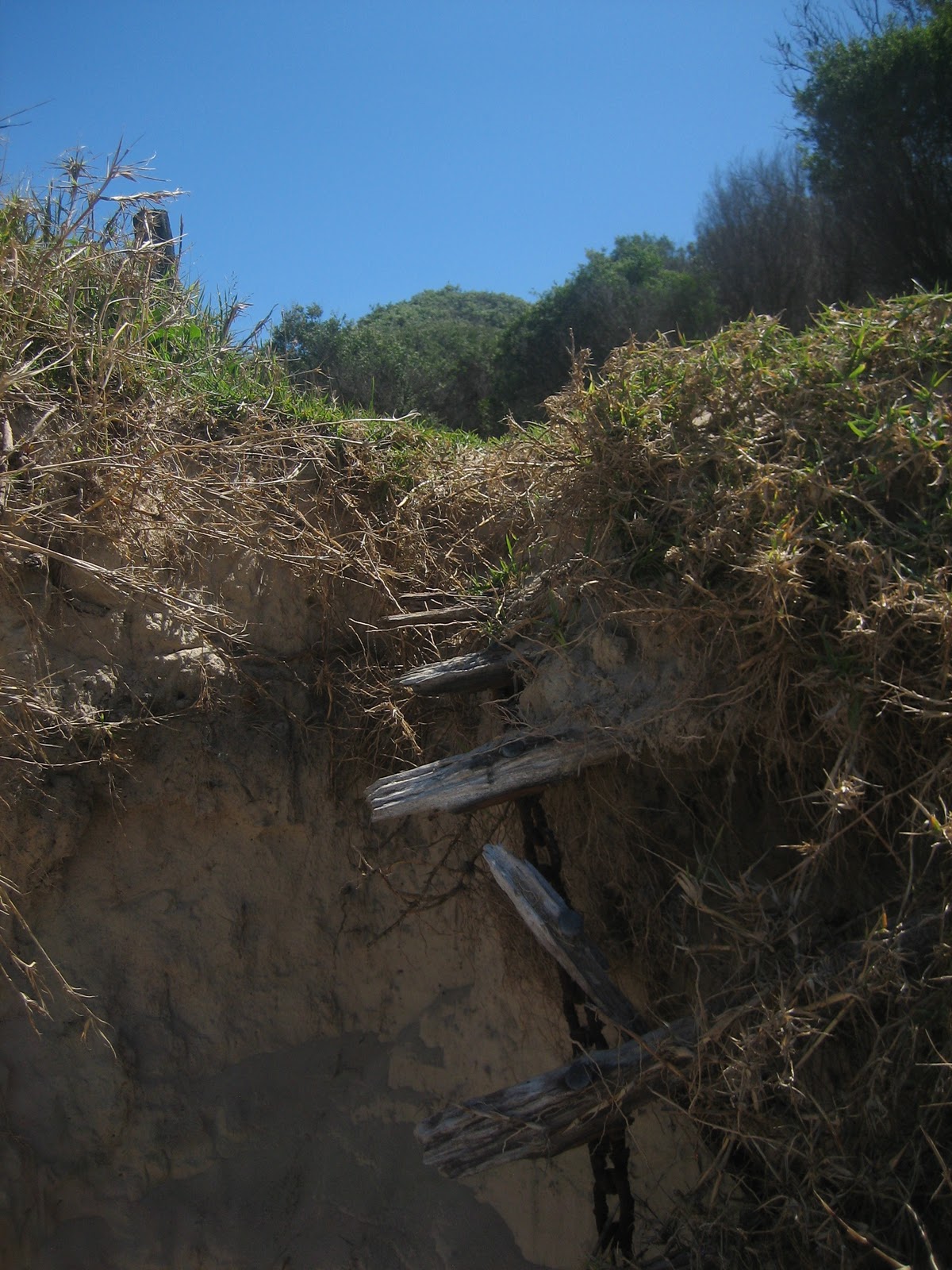
All along the beach were the signs of big tides and surf, with many trees collapsed down onto the wet sand. I read somewhere that a lot of damage was done in July just gone. In more than one spot, fences and foot planks have been turned into malicious looking ladders of rusted metal and cracked timber.


A research project in a photograph. The surf club at Scott's Head seems to me an improbable structure, something I would expect to see in a Greek-dominated street in West End. I walked around it, and had thought it completely shut, but that evening I heard at the fish n' chip shop that it still opens on the weekends, but closes at three. I took this photograph in a hurry: I wanted to catch the moment the green car passes the club house -- both survivors of a very different Australia, of big cars and red-brick buildings, that holds on in places like Scott's Head. 

And below the view through wooden steps that lead upstairs to what I expect is the club bar. I think it's a view of the beach you might carry with you from childhood.


I suppose all novels are about point of view: the form, after all, is powerful because it gives us a way of relating individual perception and time. What I wanted to do in Scott's Head was understand a character's perception in terms of how I imagined his childhood might have been. I left aware that wanting to meet your own characters in this way is very odd, and that narrative is quite possibly a form of madness. But now at least I can revisit Scott's Head, and come a step closer to how that might have felt for someone else.

Thursday, December 15, 2011

As the highway slows

...Or, as the Pacific Highway slows coming into Macksville from the north. It took me a while to find the turn-off, up to the cemetery where my grandparents' ashes are interred. I took two wrong side roads, swore at myself for forgetting where the cemetery was, and then gave up and drove on to Scott's Head, where I was staying the night. When I came back the following morning I found the right road straight away.

I took this picture. It is the view down to the highway, from a red brick wall that properly belongs at the side of a 1970s patio of plastic chairs and tables with vinyl covers, but which here is decorated with bunches of flowers the size of boutonnieres, the floral signatures of friends or relatives who visited recently; or, even not so recently, and whose flowers are browning at the edges. It was some two years since I'd been, and I came empty handed. Instead of placing flowers I passed a kiss from my hand to the plaques of Mildred and Harold Diggons, who for a few years lived with their two girls on the banks of the Nambucca River, on the opposite side from the Star Hotel, the cinema, and the milk bar. In those days, the highway ran in front of their house.


The new highway slows to 90 and then 70 and then 50, I think -- that's where you join the path of the old one as you cross the river on a narrow steel bridge built 80 years ago, during the heyday of those beautiful, industrial constructions -- just a year before the Sydney Harbour Bridge was completed. Today the bridge is actually too narrow to handle the vast numbers of trucks that pass down the highway to Sydney; in the year of its opening, only an average of 214 vehicles crossed each day.

I would say as many cars slow to cross it in the fifteen minutes that I spend with my grandparents, and that I spend once again thinking about that combination of a restless man and a hardheaded woman who didn't get on particularly well, but who perhaps got along least badly here. I am sort of writing about them in my second book, a book that will probably take me back to Yorkshire next year, where my maternal grandmother Mildred was born and raised -- she was a Doncaster girl.

For now I must say I like this moment, when I stand with them and alongside a fictional world that is both theirs and mine together, and that I have come here to help fill out with a better sense of this place, their resting place and the starting point of my book. We watch the highway as it slows and crosses the river.


(Part of an earlier visit to the area, when my grandparents' ashes were interred, is described here.)

Monday, December 12, 2011

The Pictures of Iceland

One of the most gratifying things to come out of publishing my memoir has been the very positive response that readers have had to my mother's characterization. Many think of hers as the dominant story, or the conversation between her and me that the memoir implies as the work's central dialogue.

I think that's right. And, for my part, I think that the conversation we are having is about how we have gone about defining the nature of home, both individually and together. It's something we've both fought to recover from a basic family impulse that home is always off in the distance somewhere. At its core, The Promise of Iceland is an attempt to represent a lifelong journey, it is a traveller's account of discovering belonging -- or a sense of belonging that I have long been convinced was a continuation of my parents' and grandparents' journeys home.

Naturally, readers would like to know more about her, and one of the first questions I'm asked is, how does she feel about the book now that it's out? If I was altogether sure of the answer to that question, I would give it. What I can say is that she read the final draft before it was published and let me off with a couple of minor corrections. For example, I had her rate of shorthand words per minute mixed up with her typing speed.

But readers also want to know more about how she looked. Perhaps I should have said more about that in the book, but a few months on from publication I'm sure it's okay to supplement the description here, with a mini photo essay.


This picture is taken on The Esja, a ship that would circumnavigate Iceland and take on a handful of paying passengers. Thus my mother came to understand the country as it seen from the sea, and very much fell in love.


I believe this one's from August 1972, a month before I was born.


My first home, a basement apartment in Sólvallagata that my mother moved into when she first arrived in Iceland in December 1970. On the wall, line drawings that her ex-husband Ed did while he was visiting. I just love those chairs.


A couple of early portraits, one taken by a friend, the second a studio picture.


My favourite of Mum and me together, and also here Mildred, my maternal grandmother who features in one of the opening chapters of the memoir. We are on an early visit to Melbourne, I believe.


And as the sticker says, Sydney 1977, aged 5 and just moved from Reykjavík to Mosman. (Just so everyone knows I haven't changed much.)